

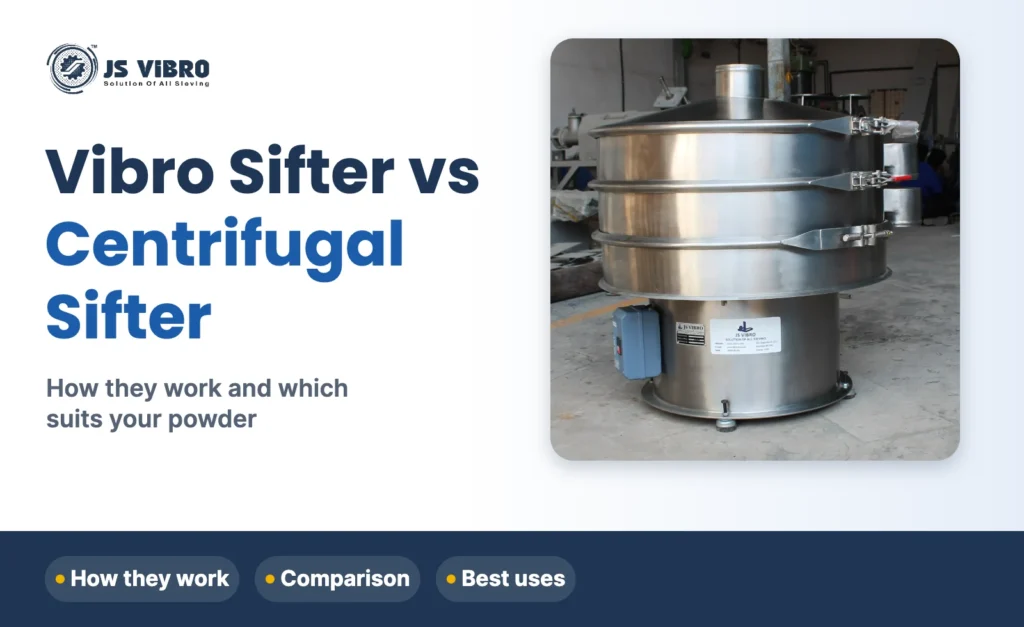
A vibro sifter shakes a flat, round screen with a vibratory motor, so particles spread across it and fall through by size; with several decks it gives up to four fractions and can also filter liquids. A centrifugal sifter uses rotating paddles inside a horizontal cylindrical screen to throw powder outwards through the mesh; it is compact and good at breaking soft lumps, but gives only two outputs: fines and oversize.
Below is how each works, a side-by-side comparison and which one suits which job. For vibro sifter sizes and prices, see our vibro sifter machine manufacturer page.
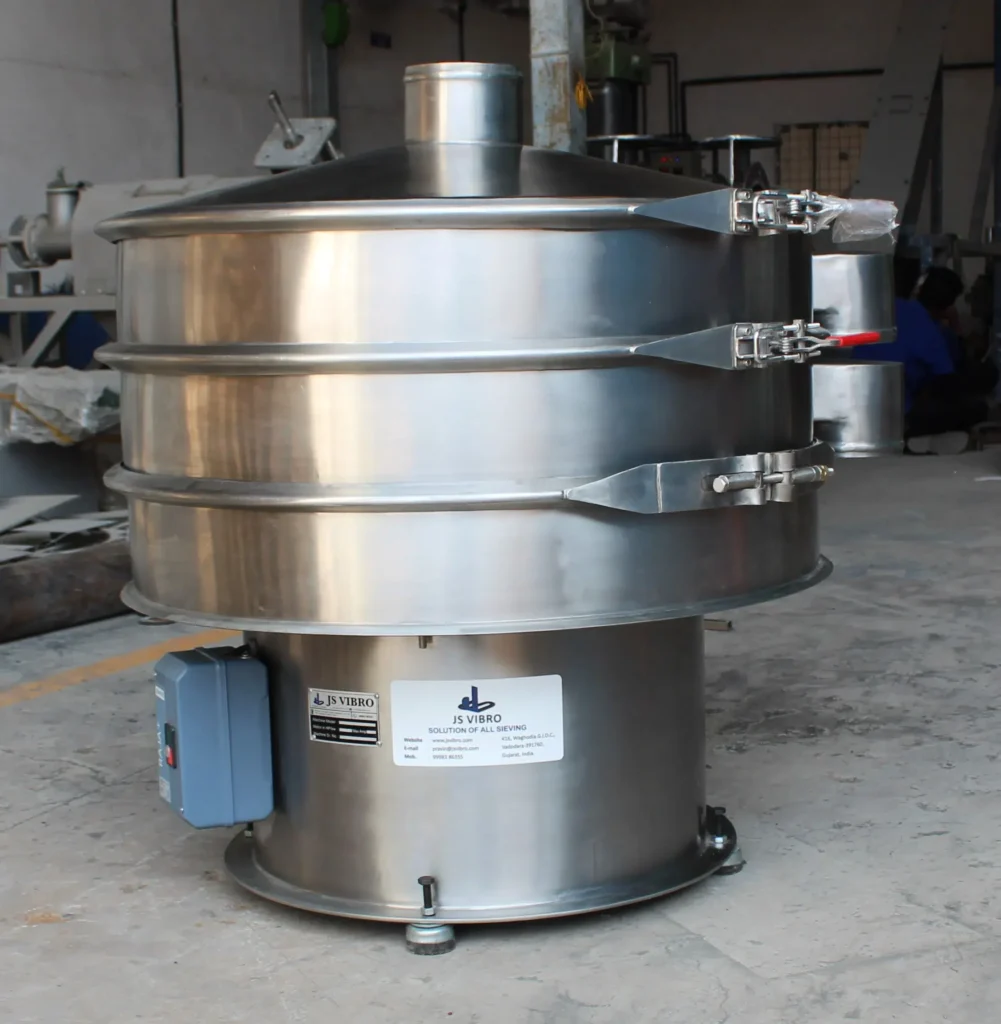
How a vibro sifter works
A vertical motor with eccentric weights gives the screen a gyratory, three-plane motion. Material spreads across the mesh; fines drop through and oversize travels to the edge outlet. Extra decks add more size cuts. The technical overview explains the motion.
How a centrifugal sifter works
Powder enters one end of a horizontal cylindrical screen. Paddles on a rotating shaft sweep it round and press it against the mesh. Fines pass through the screen; oversize travels along the cylinder and leaves at the other end. The paddles also break soft agglomerates.
Side-by-side comparison
| Vibro sifter | Centrifugal sifter | |
|---|---|---|
| Screen | Flat, round, vibrating | Cylindrical, fixed; paddles rotate inside |
| Size fractions | Up to 4 with 3 decks | 2 (fines and oversize) |
| Liquids and slurries | Yes | No |
| Soft lumps | Pass to oversize | Broken up by the paddles |
| Footprint | Round, larger diameter for higher output | Compact, horizontal |
| Cleaning | Open the clamps and lift the decks | Open the end and slide out the screen |
| Typical jobs | Grading, scalping, de-dusting, liquid filtering | Safety screening, lump breaking, inline sieving in conveying lines |
Which should you choose?
- You need more than two size fractions, or you sift liquids: a vibro sifter.
- You need to grade granules accurately for tablets, food or fertilizer: a vibro sifter.
- You need inline safety screening with lump breaking in a tight space: a centrifugal sifter may suit.
- You are not sure: send a sample and test it on both.
Capacity and mesh
Capacity on a vibro sifter rises with diameter and falls with finer mesh. Our guides to vibro sifter capacity and mesh size help you size it.
Cost and maintenance
A vibro sifter has few moving parts: the motor and its bearings. Screens and gaskets are the main wear parts. A centrifugal sifter adds a rotating shaft, paddles and shaft seals that need checking. For vibro sifter cost drivers, see the vibro sifter machine price guide.
Frequently asked questions
What is the main difference between a vibro sifter and a centrifugal sifter?
A vibro sifter vibrates a flat screen and can give up to four fractions; a centrifugal sifter uses paddles to push powder through a cylindrical screen and gives two outputs.
Can a centrifugal sifter handle liquids?
Generally no. A vibro sifter can filter liquids and slurries.
Which is better for breaking lumps?
A centrifugal sifter, because its paddles break soft agglomerates. A vibro sifter sends lumps to the oversize outlet.
Which gives more size fractions?
A vibro sifter: up to four with three decks.
Does JS Vibro make centrifugal sifters?
We specialise in vibro sifters. We can test your material and recommend the right sifter.


