

Choosing the wrong size is the most common mistake when buying a vibro sifter. Too small, and it becomes the bottleneck of your line. Too big, and you pay for capacity you never use. The right size depends less on the machine and more on your material.
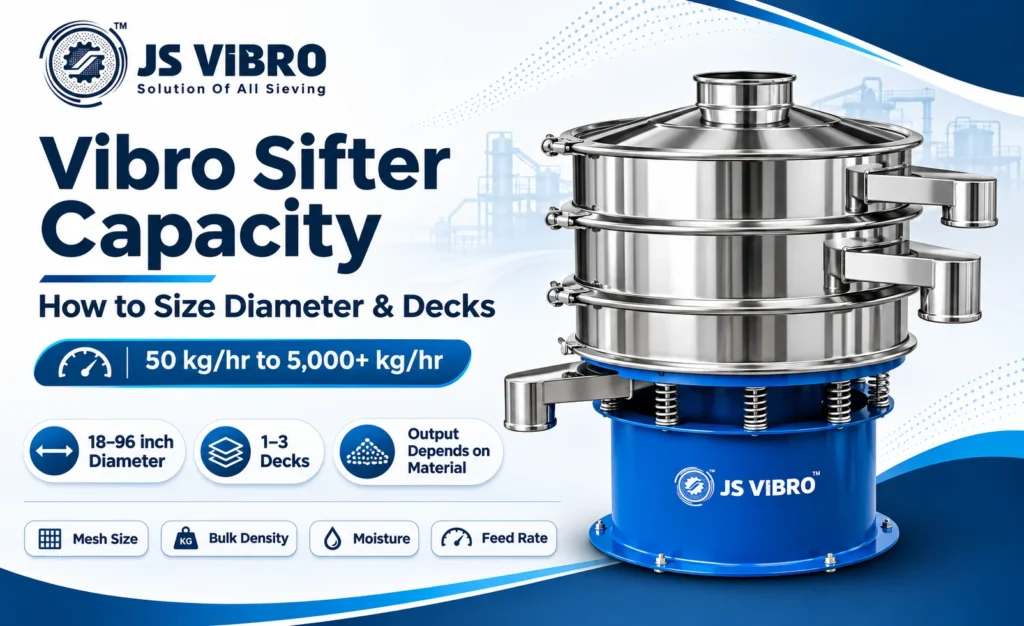
JS Vibro builds each vibro sifter machine from 18 to 96 inches in diameter with one to three decks, covering outputs from about 50 kg/hr to more than 5,000 kg/hr. This guide explains what decides capacity and how to choose the diameter and number of decks for your output.
Why there is no single capacity figure
The same machine can screen several times more free-flowing sugar per hour than a fine, sticky pharma powder. That is why any honest manufacturer gives capacity for a specific material and mesh, not a single number for the machine.
6 factors that decide vibro sifter capacity
- Mesh size. The finer the mesh, the slower particles pass through. Moving from a coarse to a very fine mesh can cut output sharply. See how to choose the right mesh size.
- Bulk density. Capacity is quoted in kg/hr, but the screen handles volume. A light, fluffy powder needs more screen area for the same weight than a dense one.
- Particle size spread. If most particles are much smaller than the mesh opening, they pass quickly. Particles close to the opening size pass slowly and limit output.
- Moisture and stickiness. Damp or hygroscopic powders clump and blind the mesh. Anti-blinding accessories help, but capacity is still lower than for a dry, free-flowing material.
- Particle shape. Round granules pass easily; flaky or fibrous particles tend to lie flat or bridge across the mesh.
- Feed rate and weight setting. An even, controlled feed and correctly set eccentric weights keep the material bed thin, which gives the fines the best chance to pass.
How capacity grows with diameter
Output rises roughly in proportion to the screen area, and screen area grows with the square of the diameter. Doubling the diameter gives about four times the area.
| Nominal diameter | Screen area (approx.) | Area compared with 24″ |
|---|---|---|
| 18″ (457 mm) | 0.16 m² | 0.56× |
| 24″ (610 mm) | 0.29 m² | 1× |
| 30″ (762 mm) | 0.46 m² | 1.56× |
| 36″ (914 mm) | 0.66 m² | 2.25× |
| 48″ (1,219 mm) | 1.17 m² | 4× |
| 60″ (1,524 mm) | 1.82 m² | 6.25× |
| 72″ (1,829 mm) | 2.63 m² | 9× |
| 96″ (2,438 mm) | 4.67 m² | 16× |
Areas are calculated from the nominal diameter; the usable screen area is slightly smaller because of the frame.
Example: suppose a trial shows that a 24-inch sifter screens your powder at 300 kg/hr. A 48-inch machine has four times the area, so it would handle somewhat less than 1,200 kg/hr of the same powder, because the material has a longer path across a larger screen. A trial on your own material is the only way to confirm the figure.
When to add decks
Adding decks does not increase output for a single separation. It lets one machine produce more grades at once:
| Decks | Fractions out | Typical use |
|---|---|---|
| 1 | 2 (fines and oversize) | Removing lumps or foreign matter, check-sieving |
| 2 | 3 | Grading granules into under-size, on-size and over-size |
| 3 | 4 | Multi-grade classification in one pass |
If you need only one cut, choose a single deck and spend the budget on diameter instead. Read single deck vs multi-deck vibro sifter for more detail.
One large sifter or two small ones?
- One large machine costs less per kg of capacity and takes one feed point.
- Two smaller machines give a backup if one is down for cleaning or a screen change, and can run different products at the same time.
Plants with frequent product changes, such as pharma, often choose two smaller units for flexibility.
How to get your vibro sifter sized correctly
Send these details and our engineers will recommend the diameter, decks and motor:
- Material name and a short description (powder, granules, liquid)
- Required output in kg/hr
- Mesh size or the particle size you need
- Bulk density, if known
- Moisture level or stickiness
- Number of grades required
For the cost side, see vibro sifter price in India. When you are ready, send your material for sizing and we will recommend the right machine.
Frequently asked questions
What is the capacity of a vibro sifter?
JS Vibro vibro sifters cover about 50 kg/hr to more than 5,000 kg/hr. The actual figure for your machine depends on your material, mesh size and diameter.
Does a finer mesh reduce vibro sifter capacity?
Yes. Finer mesh openings let particles through more slowly, so output falls as the mesh gets finer.
Do more decks increase output?
No. Extra decks give more grades in one pass; to increase output for a single separation, choose a larger diameter.
How do I calculate the vibro sifter size I need?
Start from your required kg/hr, material and mesh. Screen area grows with the square of the diameter, but a trial on your material gives the reliable figure.
Can you test my material before I buy?
Send us your material details; our engineers will recommend the size and confirm output for your application.


