

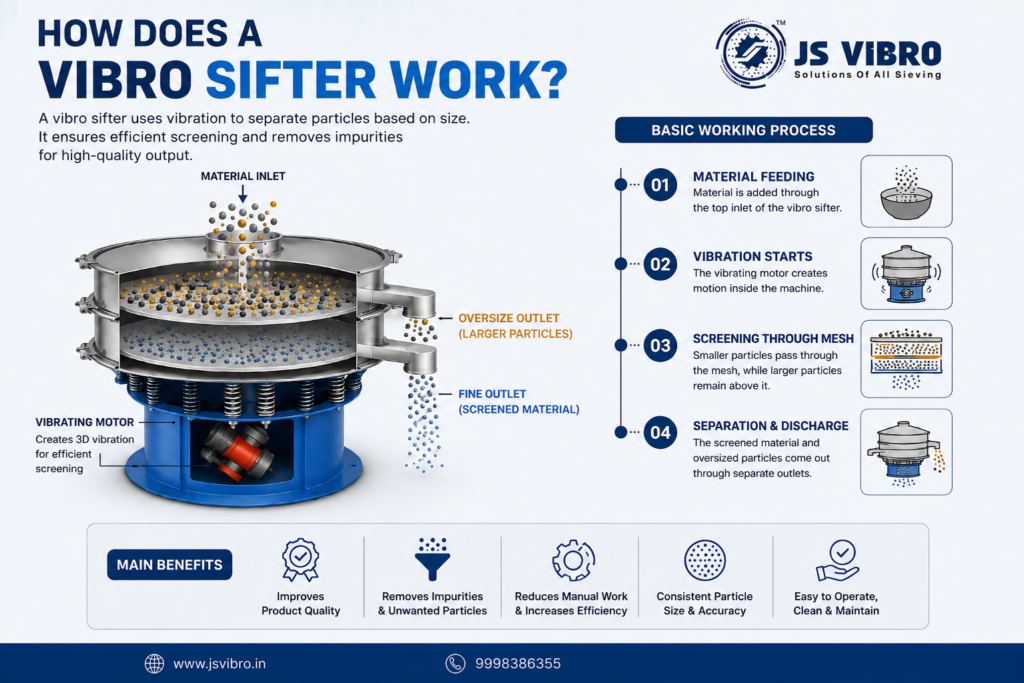
The Vibro Sifter is one of the most widely used separation machines in industrial processing, yet many buyers purchase them without fully understanding how they work. This article provides a complete technical overview of Vibro Sifter operation — from motor mechanics to separation physics — helping engineers and procurement teams make better-informed decisions.
The working principle of a Vibro Sifter
A Vibro Sifter operates on the principle of gyratory vibration. A specially designed vibratory motor, fitted with adjustable eccentric weights at both the top and bottom of its shaft, generates a three-dimensional motion when energised. This motion — simultaneously vertical, horizontal, and rotary — causes material fed onto the sieve screen to follow a spiral path from the centre outward toward the periphery.
Fine particles that meet the mesh aperture fall through the screen into a collection tray below. Oversized particles that cannot pass through travel to the peripheral discharge spout and exit the machine. In multi-deck Vibro Sifters, this process occurs across two or three screens stacked vertically, each with a progressively finer mesh, allowing simultaneous multi-fraction separation.
Understanding eccentric weight adjustment
The motion pattern of a Vibro Sifter is controlled by two sets of eccentric weights: the top weight and the bottom weight. Changing their angular offset changes the nature of vibration:
- Top weight adjustment — controls the horizontal component of motion; affects how quickly material moves toward the discharge outlet
- Bottom weight adjustment — controls the vertical component; affects stratification and the probability of fine particles passing through the mesh
- Combined adjustment — tuning both weights allows the operator to optimise for either high throughput or high separation accuracy depending on the material
Vibro Sifter vs. linear vibrating screen
A common point of confusion is the difference between a Vibro Sifter (circular gyratory) and a linear vibrating screen. Both perform particle separation, but they are suited to different applications.
Vibro Sifters generate gyratory, multi-directional motion and are best suited for fine mesh separation (below 500 microns), small to medium throughputs, and materials that tend to clump or blind the screen. Linear vibrating screens use back-and-forth motion, are better for coarser separations and high-volume dewatering, but perform poorly below 100 mesh.
Materials that can be processed in a Vibro Sifter
The Vibro Sifter is a versatile machine that handles a broad range of materials:
- Free-flowing dry powders — API, talc, chalk, starch, sugar, salt
- Cohesive or mildly sticky powders — with the help of anti-blinding accessories like bouncing balls or ultrasonic deblinding
- Granules — pharmaceutical granules, plastic pellets, fertiliser prills
- Slurries and suspensions — ceramic slips, paint, coating dispersions (wet sieving configuration)
- Fibrous materials — with special mesh configurations to prevent entanglement
Understanding how a Vibro Sifter machine works allows engineers to configure the machine correctly, choose the right accessories, and troubleshoot separation issues confidently. The gyratory three-dimensional motion, adjustable eccentric weights, and wide material compatibility make the Vibro Sifter one of the most versatile screening machines available for industrial processing. If you are evaluating a Vibro Sifter for your facility, ensure the manufacturer offers customisation of eccentric weight settings and mesh frame options to match your specific material.


