

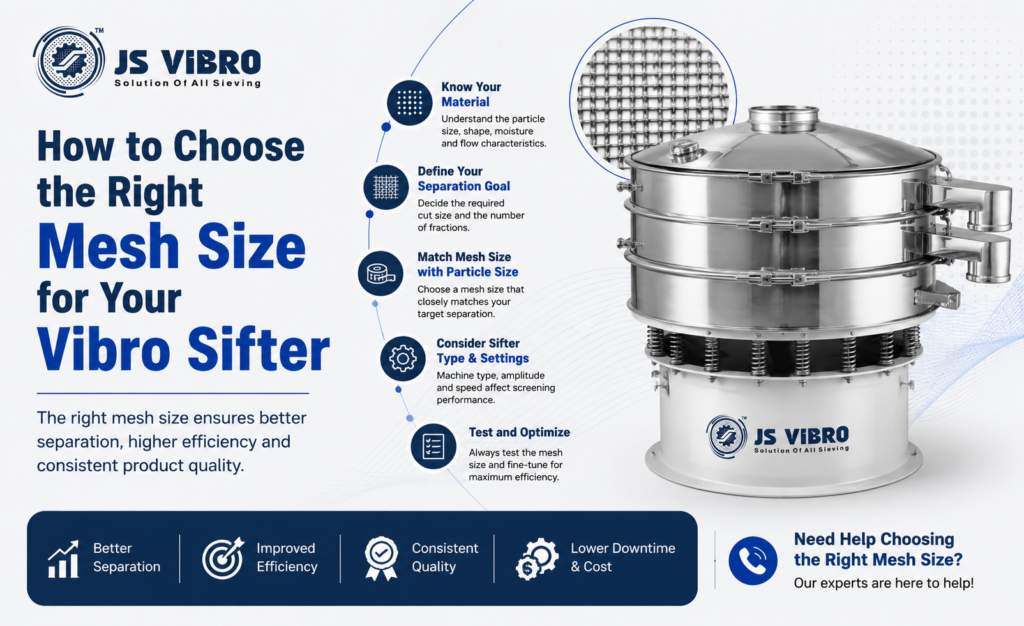
Choosing the right mesh size for your vibro sifter is important for product quality, screening speed, and smooth machine performance. A vibro sifter separates particles based on size. The mesh decides which particles pass through and which particles stay on the screen. If the mesh size is too large, unwanted oversized particles may pass into the final product. If the mesh size is too fine, the material may clog the screen and reduce output.
Mesh size is usually linked with micron size and aperture opening. Mesh number tells how many openings are present in one linear inch of screen. A higher mesh number usually means a smaller opening. For example, 40 mesh is coarser than 100 mesh. Micron size gives a clearer idea of the actual particle opening. Standard sieve charts are often used to compare mesh number, millimetres, inches, and microns.
Understand What Mesh Size Means
Mesh size refers to the number of openings in a screen per linear inch. It helps decide the size of material that can pass through the sieve. In simple words, mesh size controls the final particle size of the screened material.
For example, a 20 mesh screen has larger openings than an 80 mesh screen. So, larger particles can pass through 20 mesh, while only finer particles can pass through 80 mesh. This is why the selection of mesh size should always depend on your final product requirement.
Many industries use mesh size and micron size together. Microns give the exact opening size. This makes selection easier when your product needs accurate particle separation. For high quality screening, always check both mesh number and micron value.
Know Your Required Particle Size
The first step is to understand the particle size you want in the final product. Every material has a different size requirement. Food powders, chemical powders, minerals, spices, ceramic materials, and pharmaceutical ingredients all need different mesh sizes.
For example, if you want to remove large impurities from a powder, a medium mesh may be enough. If you want a very fine powder, you will need a finer mesh. If your target particle size is 250 microns, your mesh should match that requirement.
A particle size conversion chart can help you compare mesh number with micron size. Such charts show common sieve openings from large sizes to fine sizes. This helps users choose the right screen instead of guessing.
Consider the Type of Material
The type of material plays a major role in mesh selection. Some materials are dry and free flowing. Some are sticky, oily, wet, or irregular in shape. A mesh that works well for one material may not work well for another.
Free flowing powders can pass through fine mesh more easily. Sticky or moist materials may block the screen. Granules may need a coarser mesh. Fibrous materials may need special screen design or better vibration control.
You should check the material properties before finalising the mesh. Important factors include particle shape, density, moisture, oil content, stickiness, and flowability. A material with poor flow may need a slightly larger opening to avoid clogging.
Check Moisture Content
Moisture is one of the biggest reasons for mesh blocking. If the material contains high moisture, it may stick to the wire mesh. This reduces open area and slows down screening. It can also cause uneven output.
Dry material usually gives better screening efficiency. Wet or damp material may need a coarser mesh or anti blinding arrangement. Anti blinding systems help keep the mesh clean during operation. These may include bouncing balls, sliders, ultrasonic systems, or special screen cleaning attachments.
Before selecting a fine mesh, always test the moisture level of your material. If your material absorbs moisture from the air, keep it dry before feeding it into the vibro sifter. This improves both capacity and accuracy.
Match Mesh Size with Screening Capacity
Moisture is one of the biggest reasons for mesh blocking. If the material contains high moisture, it may stick to the wire mesh. This reduces open area and slows down screening. It can also cause uneven output.
Dry material usually gives better screening efficiency. Wet or damp material may need a coarser mesh or anti blinding arrangement. Anti blinding systems help keep the mesh clean during operation. These may include bouncing balls, sliders, ultrasonic systems, or special screen cleaning attachments.
Before selecting a fine mesh, always test the moisture level of your material. If your material absorbs moisture from the air, keep it dry before feeding it into the vibro sifter. This improves both capacity and accuracy.
Understand Screen Blinding and Clogging
Moisture is one of the biggest reasons for mesh blocking. If the material contains high moisture, it may stick to the wire mesh. This reduces open area and slows down screening. It can also cause uneven output.
Dry material usually gives better screening efficiency. Wet or damp material may need a coarser mesh or anti blinding arrangement. Anti blinding systems help keep the mesh clean during operation. These may include bouncing balls, sliders, ultrasonic systems, or special screen cleaning attachments.
Before selecting a fine mesh, always test the moisture level of your material. If your material absorbs moisture from the air, keep it dry before feeding it into the vibro sifter. This improves both capacity and accuracy.
Select Mesh Based on Industry Requirement
Different industries use vibro sifters for different purposes. This is why mesh selection should match the application.
In the food industry, vibro sifters are used for flour, sugar, spices, milk powder, and grains. These materials may need impurity removal or fine powder grading. In the pharmaceutical industry, mesh selection is more critical because particle size affects product quality and consistency. In the chemical industry, materials may be fine, abrasive, sticky, or reactive. In the mineral industry, the material may be heavy and abrasive.
Each industry also follows its own quality standards. Standard test sieves and defined opening sizes are used in many industries to maintain accuracy. ASTM sieve related standards include specifications for sieve openings and tolerances, which are useful for accurate particle separation work.
Choose the Right Screen Material
Mesh size is not the only factor. Screen material is also important. Most vibro sifter machines are made from stainless steel wire mesh. Stainless steel is preferred because it is strong, corrosion resistant, and suitable for hygienic applications.
For food and pharma use, stainless steel is commonly selected because it is easier to clean. For abrasive materials, stronger wire and better screen support may be needed. For corrosive chemicals, the screen material must resist chemical damage.
Wire diameter also affects screening performance. Thick wire gives more strength but reduces open area. Thin wire gives more open area but may wear faster. So, you need to choose the right balance between strength and open area.
Decide Between Single Deck and Multi Deck Screening
A single deck vibro sifter uses one screen to separate material into two parts. One part passes through the mesh, and the other part stays above the mesh. This is suitable for simple safety screening or impurity removal.
A multi deck vibro sifter uses two or more screens. It can separate material into multiple grades. For example, it can separate fine powder, medium particles, and oversized particles in one process.
If you need only one final product size, a single deck machine may be enough. If you need multiple particle grades, choose a multi deck system. Each deck will need a different mesh size based on the required separation level.
Conduct Trial Testing Before Final Selection
Trial testing is one of the best ways to choose the correct mesh size. It helps you check real performance with your actual material. Even if you know the particle size, the actual screening result may change due to moisture, density, shape, and flowability.
During testing, check the following points:
- Material flow on the screen.
- Screening speed.
- Final product quality.
- Oversized particle removal.
- Mesh clogging.
- Machine vibration performance.
- Output per hour.
After trial testing, you can decide whether the mesh is too fine, too coarse, or suitable. This prevents production problems later.
Common Mesh Selection Mistakes
Many users select mesh size only by guessing. This can create quality and production problems. One common mistake is choosing a very fine mesh for faster quality improvement. Fine mesh may improve separation, but it can also reduce output and increase clogging.
Another mistake is ignoring material moisture. Even the correct mesh may fail if the material is wet or sticky. Some users also ignore wire diameter and screen strength. This can lead to mesh damage, especially when screening heavy or abrasive materials.
You should also avoid using the same mesh for all materials. Each material behaves differently inside a vibro sifter. A mesh that works for dry flour may not work for damp chemical powder or heavy mineral granules.


