Ribbon Blender

JS Vibro is a Ribbon Blender Manufacturer in India, providing industrial mixing solutions for powders, granules, dry ingredients, and other bulk materials. Our ribbon blender machines are designed for consistent mixing, smooth operation, easy discharge, and long-term use in demanding production environments.

Manufactured in Vadodara, Gujarat, our ribbon blenders are available in MS, SS 304, SS 316, and SS 316L construction. Different capacities and configurations can be supplied to suit food processing, pharmaceutical, chemical, cosmetics, agriculture, animal feed, construction chemicals, and other industries.

Whether you need a small ribbon blender for controlled batch production or a large industrial ribbon blender for bulk manufacturing, JS Vibro can configure the machine according to your material, batch size, process, and plant requirements.

Ribbon Blender Machine
Sq. ft. Manufacturing Facility
0 +
Years Expertise
0 +
Industrial Sectors
0 +
Clients Served
0 +

What is a Ribbon Blender Machine?

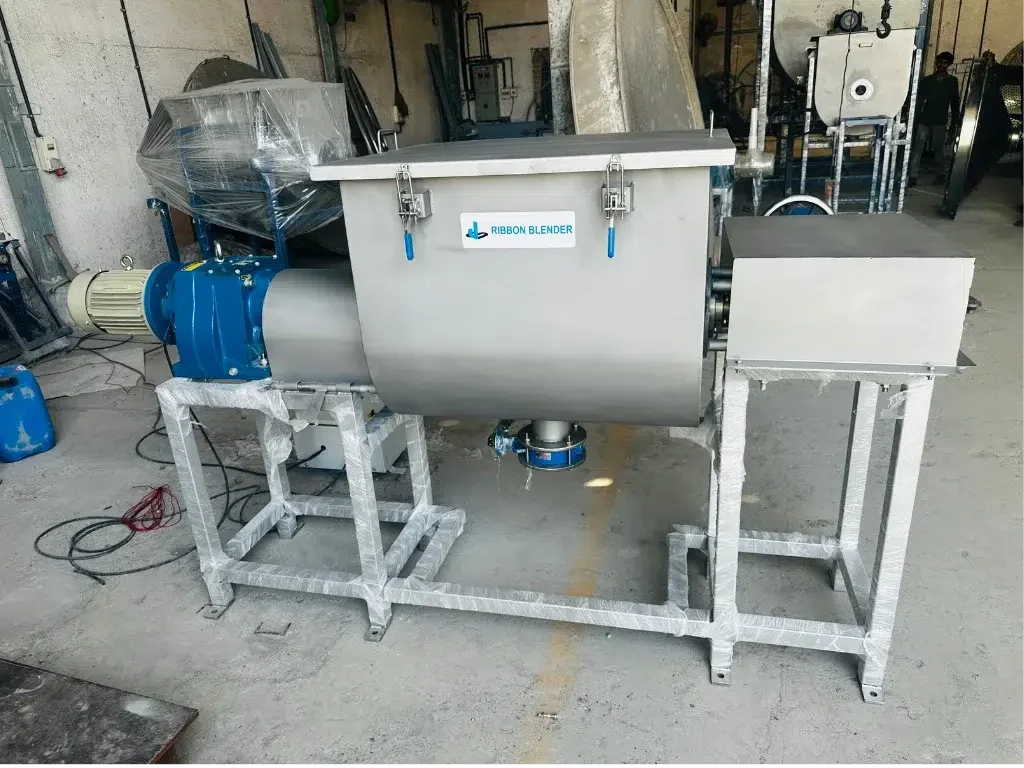
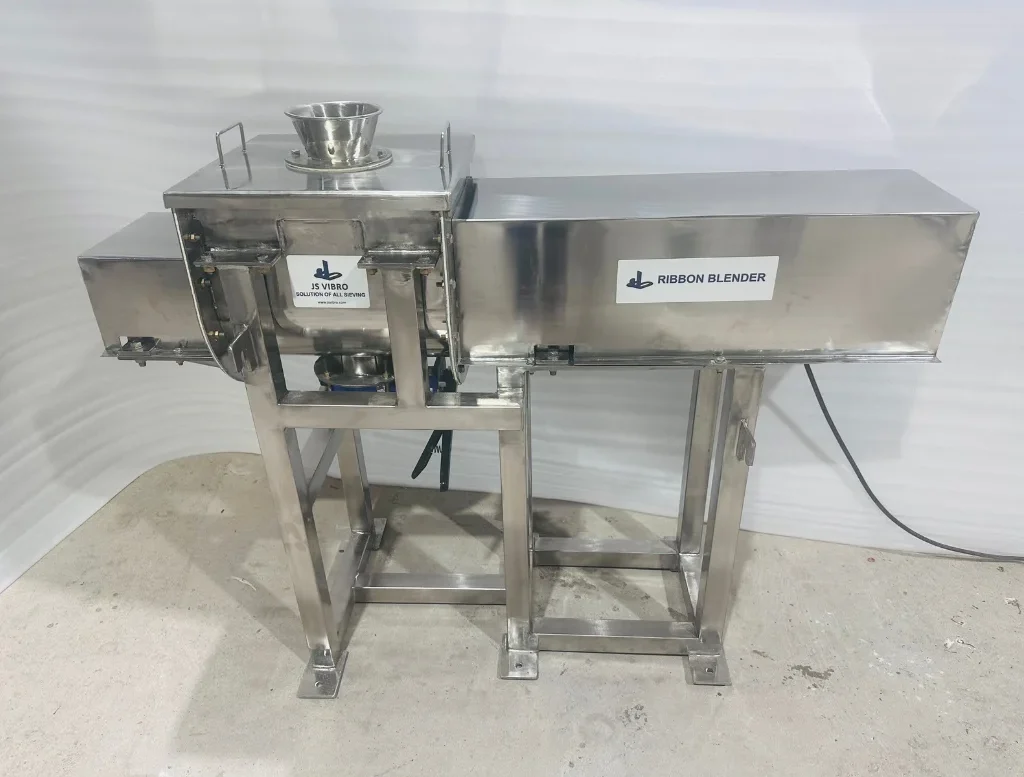
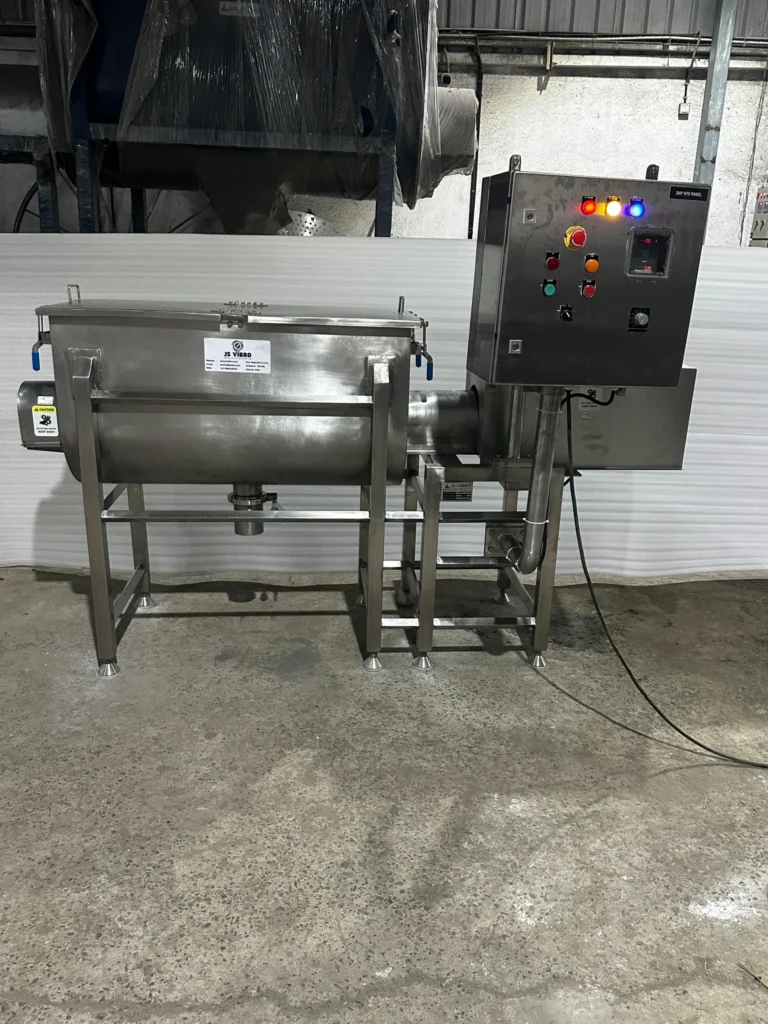
A Ribbon Blender Machine is a horizontal industrial mixer used for blending dry powders, granules, flakes, and similar bulk materials.

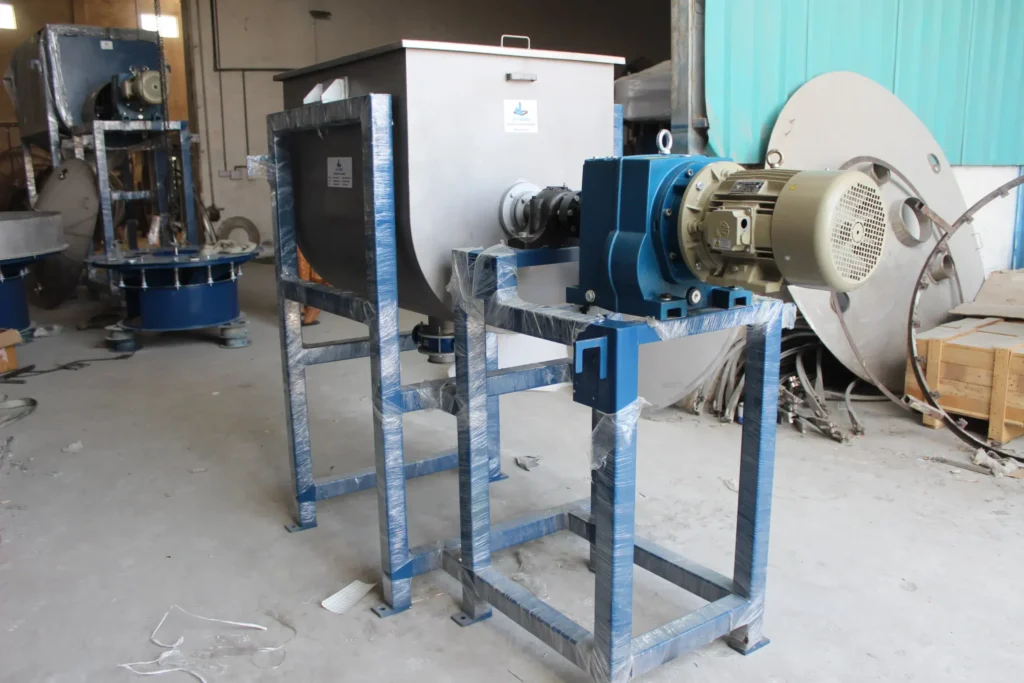
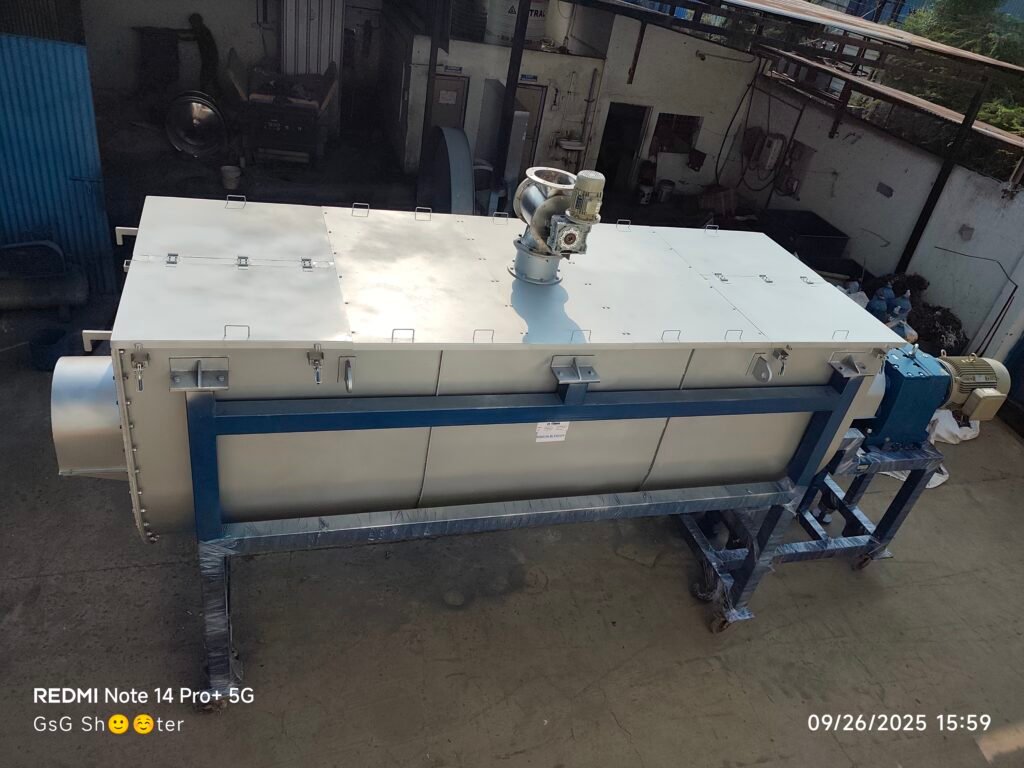
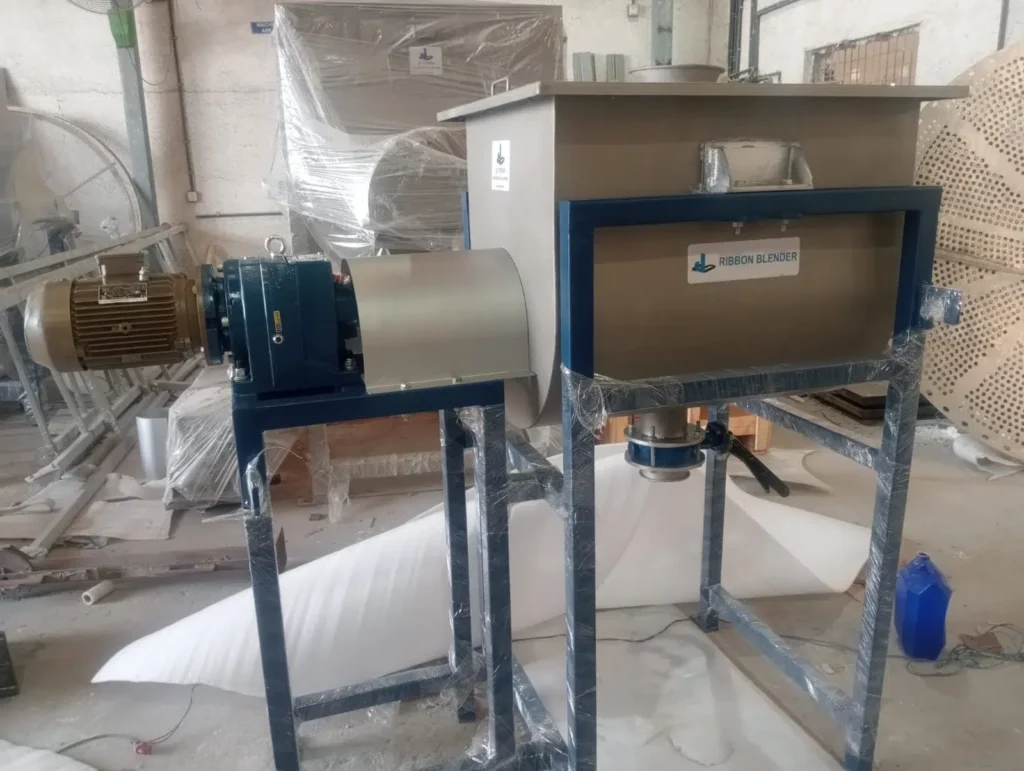
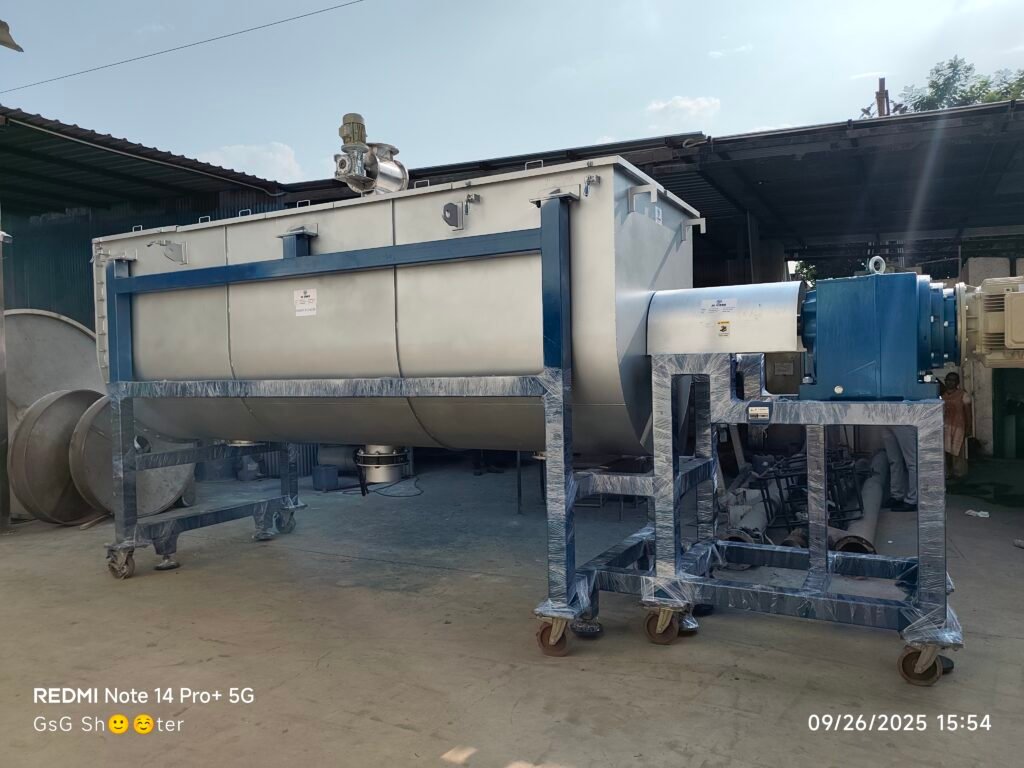
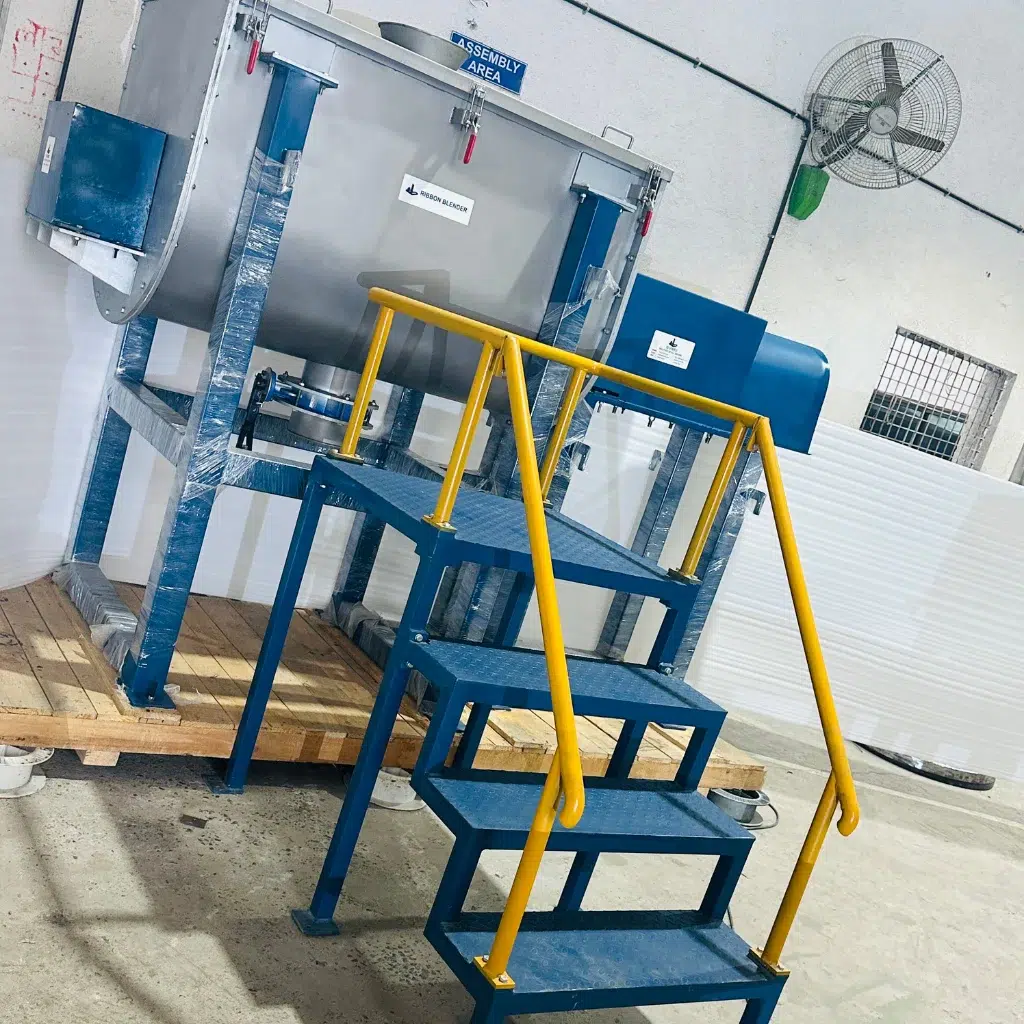
It has a U-shaped mixing trough with a horizontal shaft fitted with inner and outer helical ribbons. During operation, the ribbons move material in opposite directions, creating continuous circulation and helping produce a uniform blend.

Ribbon blenders are commonly used in the pharmaceutical, food, chemical, cosmetic, plastic, and mineral industries.

They are also known as:

  • Ribbon Mixer
  • Ribbon Mixer Machine
  • Horizontal Ribbon Blender
  • Powder Ribbon Blender
  • Double Ribbon Blender
  • Powder Mixing Machine

Ribbon Blender Machine Working Principle

How Does a Ribbon Blender Work?

1. Material Loading
Powders or granules are loaded into the U-shaped trough from the top.

2. Ribbon Rotation
The motor and gearbox rotate the shaft and double helical ribbon.

3. Counter-Current Mixing
The outer ribbon moves material in one direction, while the inner ribbon moves it in the opposite direction.

4. Uniform Blending
Continuous folding and circulation distribute ingredients throughout the batch.

5. Material Discharge
After mixing, the finished product is discharged through the bottom outlet.

Typical mixing time is around 10–20 minutes, depending on material properties, batch size, and machine configuration.

Ribbon Blender Machine Manufacturer in India

As a Ribbon Blender Machine Manufacturer in India, JS Vibro provides customised solutions based on material type, batch size, mixing requirements, and discharge needs. Machines are available with options such as VFD control, spray systems, heating or cooling jackets, load cells, and PLC automation. JS Vibro also supports customers with machine selection, technical guidance, export packaging, documentation, and shipping assistance.

Ribbon Blender Machine Technical Specifications

Parameter Specification
Construction Material
MS / SS 304 / SS 316 / SS 316L
Batch Capacity
50 kg to 5,000 kg per batch
Trough Volume
100 litres to 10,000 litres
Ribbon Agitator
Double helical (inner + outer)
Motor Power
1 HP to 30 HP
Drive
Helical gear motor / VFD optional
Shaft Speed
30 to 60 RPM
Mixing Time
10 to 20 minutes
Discharge
Flush-bottom butterfly valve / sliding gate
Surface Finish
Mirror Polish / Matte / Bead Blast
Compliance
GMP, cGMP, FDA
Voltage
220V Single Phase / 440V Three Phase
Seal Type
Stuffing box / Mechanical seal / Lip seal
Jacket
Heating / Cooling (optional)
Automation
Manual / Semi-auto / PLC / SCADA

Note: Custom specifications are available for non-standard batch sizes, special materials, explosion-proof environments, and regulated industry requirements.

Key Features & Benefits of Vibro Ribbon Blenders

Uniform Blend Homogeneity The counter-current double ribbon action ensures RSD < 5% blend uniformity — meeting pharmaceutical, food, and cosmetic regulatory standards for consistent end-product quality.

Wide Capacity Range Available from 50 kg to 5,000 kg per batch — scalable from lab/pilot scale to full industrial production without changing process parameters.

Fast Mixing Cycles Most materials reach homogeneity within 10–20 minutes, significantly reducing cycle time versus paddle mixers or tumbler blenders, improving overall production throughput.

Handles Diverse Materials Free-flowing powders, cohesive powders, granules, flakes, fibrous materials, low-viscosity pastes, and liquid additions (spray nozzles available) — the ribbon blender handles them all in a single unit.

GMP-Compliant Design Options
Mirror-polished SS 316L, mechanical seals, flush-bottom discharge, CIP connection, and documentation packages make JS Vibro ribbon blenders ready for regulated pharmaceutical and food manufacturing environments.

Easy Cleaning & Maintenance
Hinged top covers, flush-bottom discharge, and smooth internal finishes allow full manual cleaning or automated CIP in minimal time. Open bearing design simplifies bearing inspection and replacement.

Low Energy Consumption
Helical gear motor drives and optimised ribbon geometry deliver efficient mixing with minimal motor load, resulting in lower energy consumption per batch compared to competing mixer designs.

Customization Capability Jacket, VFD drive, load cells for in-process weighing, spray bar for liquid addition, PLC/SCADA automation, explosion-proof execution, custom trough dimensions — JS Vibro builds to your exact specification.

Ribbon Blender Machine Price in India

Ribbon Blender Price Range

The ribbon blender machine price in India varies based on batch capacity, construction material, surface finish, drive type, and additional features. JS Vibro offers direct manufacturer pricing — no middlemen, no inflated margins.

Note: Prices are indicative. Contact JS Vibro for an exact quotation based on your application requirements.

Parameter Specification
Small Batch (50–200 kg) — MS/SS 304
₹45,000 – ₹80,000
Standard (200–500 kg) — SS 304
₹80,000 – ₹1,50,000
GMP Pharma Model — SS 316L
₹1,20,000 – ₹2,50,000
Medium Capacity (500–1,000 kg)
₹1,50,000 – ₹3,00,000
Large Industrial (1,000–2,000 kg)
₹2,50,000 – ₹4,50,000
Heavy Duty (2,000–5,000 kg)
5,000 kg)₹4,00,000 – ₹8,00,000+
Jacketed / PLC / Explosion-Proof
₹2,00,000 – ₹10,00,000+

See Our Products in Action

Explore how JS Vibro machines perform — real visuals of design, movement, and results.

Ribbon Blender Machine

Ribbon Blender FAQs

What is a Ribbon Blender Machine?

A Ribbon Blender Machine is a horizontal industrial mixer used for blending powders, granules, flakes and similar bulk materials. It typically uses inner and outer helical ribbons mounted on a central shaft inside a U-shaped trough.

How does a Ribbon Blender work?

A Ribbon Blender works by moving material in opposite directions through inner and outer helical ribbons. The outer ribbon generally moves material towards the centre, while the inner ribbon moves it back towards the ends, creating continuous axial and radial mixing.

What materials can be mixed in a Ribbon Blender?

Ribbon Blenders are commonly used for dry powders, granules, flakes and other bulk solids. Depending on machine configuration and material properties, they can also be designed for certain semi-wet materials or controlled liquid addition.

Which industries use Ribbon Blender Machines?

Ribbon Blenders are widely used in food processing, pharmaceutical, chemical, cosmetics, agriculture, animal feed, plastics and construction-material applications where batch blending is required.

What capacity Ribbon Blenders does JS Vibro manufacture?

According to JS Vibro's current product specifications, Ribbon Blenders are available with batch capacities from approximately 50 kg to 5,000 kg and trough volumes from 100 litres to 10,000 litres. Custom configurations are also available depending on the application.

Which materials of construction are available for JS Vibro Ribbon Blenders?

JS Vibro lists Mild Steel, SS 304, SS 316 and SS 316L as available construction materials. The appropriate material depends on the product being mixed, hygiene requirements, corrosion resistance and industry application.

How long does a Ribbon Blender take to mix a batch?

JS Vibro lists a typical mixing time of approximately 10–20 minutes per batch. Actual mixing time can vary depending on material characteristics, batch size, fill level, ribbon design and the required level of uniformity.

What is the recommended filling level for a Ribbon Blender?

Ribbon Blenders generally require enough material to properly engage the ribbon agitator. JS Vibro indicates a working fill range of approximately 40–70% of trough capacity, while other established Ribbon Blender designs also operate within defined minimum and maximum fill ranges.

What is the difference between a Ribbon Blender and a Paddle Mixer?

A Ribbon Blender uses continuous inner and outer helical ribbons to move material in opposing directions. A paddle mixer uses individual paddles and may be more suitable for certain fragile materials or applications requiring lower minimum batch volumes. The right mixer depends on material behaviour and process requirements.

Can liquid be added while using a Ribbon Blender?

Yes. A Ribbon Blender can be designed with spray bars or liquid-addition arrangements for suitable applications. However, the amount and type of liquid must be evaluated according to the powder characteristics and required final product consistency.

Can the speed of a Ribbon Blender be adjusted?

Yes. JS Vibro lists a typical shaft speed of 30–60 RPM, and a Variable Frequency Drive (VFD) can be provided when adjustable mixing speed is required. The appropriate speed depends on material properties and blender size.

What discharge options are available for a Ribbon Blender?

Ribbon Blenders can use bottom discharge arrangements such as butterfly valves, sliding gates and other customised discharge systems. JS Vibro offers different discharge configurations depending on the material and production process.

Can a Ribbon Blender be supplied with heating or cooling?

Yes. JS Vibro lists heating or cooling jackets as an optional configuration. Jacketed Ribbon Blenders can be considered when temperature control forms part of the mixing process.

Can a Ribbon Blender be customised?

Yes. JS Vibro states that Ribbon Blenders can be configured according to batch size, construction material, ribbon design, discharge arrangement, VFD, heating or cooling jacket, automation and other process requirements.

How do I choose the right Ribbon Blender capacity?

The correct capacity should be selected using the required batch weight, material bulk density and recommended working fill level rather than batch weight alone. Sharing these details with the manufacturer helps determine the appropriate trough volume and drive configuration.

What information should I provide before requesting a Ribbon Blender quotation?

Provide the material name, bulk density, required batch size, desired mixing time, construction material, discharge method and any special requirements such as liquid addition, heating, cooling, VFD or automation. This helps the manufacturer configure a more suitable machine.

What is the Ribbon Blender price in India?

Ribbon Blender prices vary according to capacity, construction material, motor and gearbox size, surface finish, discharge system, automation and optional features. JS Vibro therefore recommends selecting the machine based on the actual application before obtaining a final quotation. JS Vibro Experts