

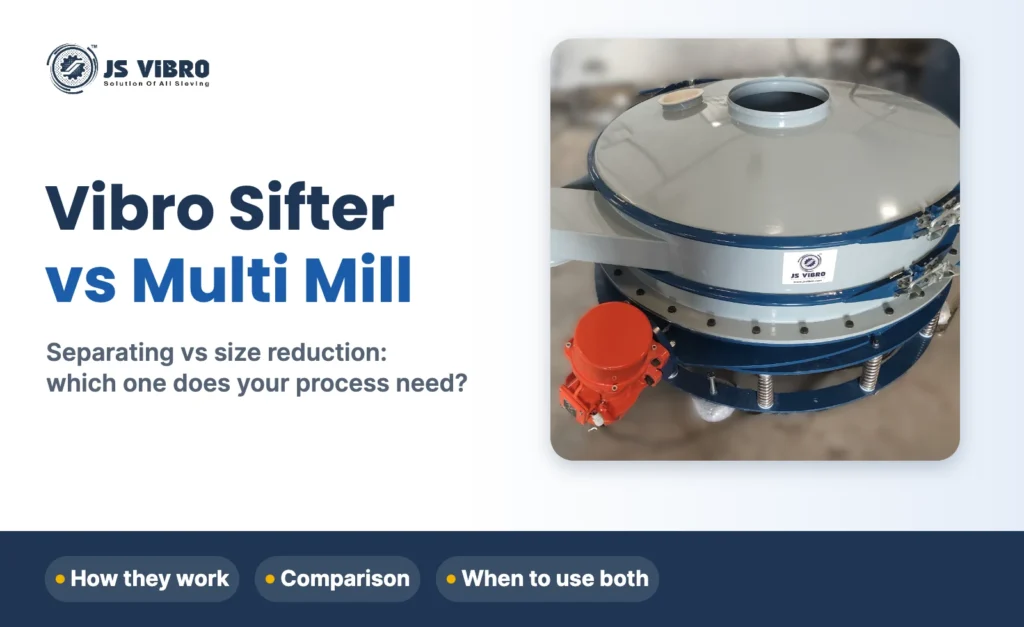
A vibro sifter and a multi mill do different jobs. A vibro sifter separates powder or granules by size on a vibrating screen and does not break particles. A multi mill reduces size: rotating blades or knives force material through a screen until the particles are small enough to pass. Many plants use both, milling first and then sifting.
This guide explains how each machine works, compares them side by side and shows where each fits. For sizes and prices of sifters, see our vibro sifter page.
How a vibro sifter works
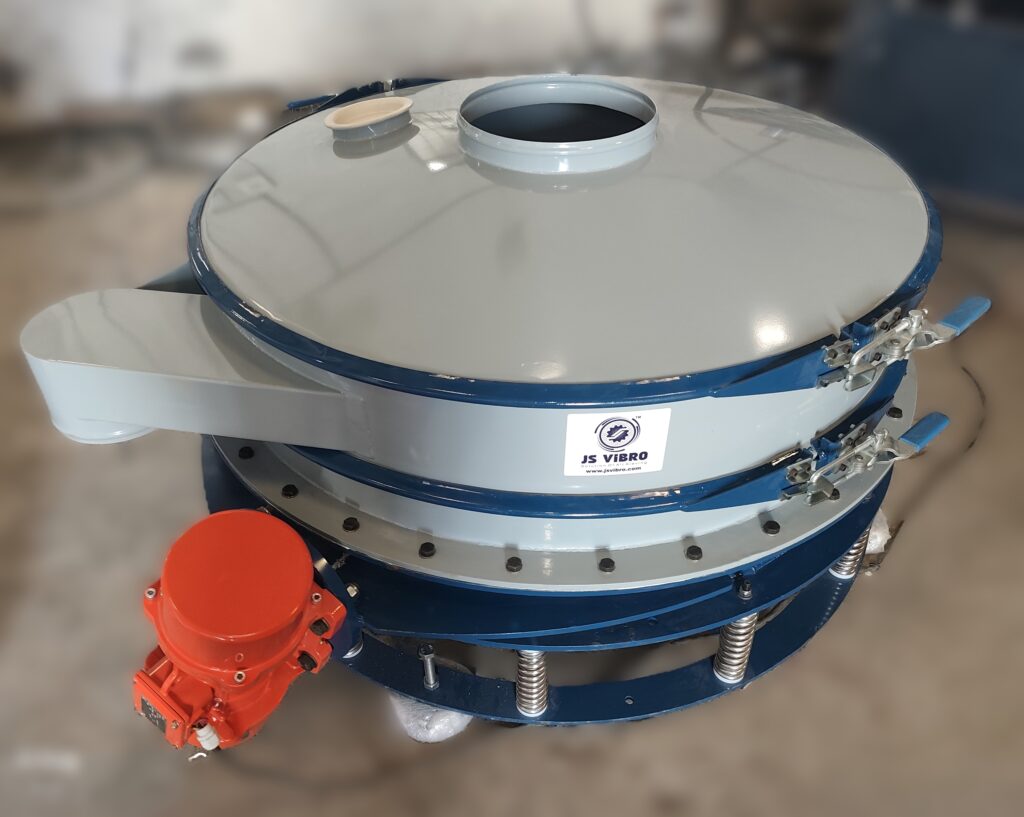
A vibratory motor with eccentric weights makes the screen gyrate and tilt. Particles smaller than the mesh opening fall through; larger ones travel to an outlet. With up to three decks, one pass can give up to four size fractions. Our technical overview covers the motion in detail.
How a multi mill works
A multi mill has a rotor with blades that turn at high speed inside a chamber with a screen. The blades cut or impact the material until the pieces pass the screen. Changing the screen size, the blade side (knife or impact edge) and the rotor speed changes the particle size produced.
Side-by-side comparison
| Vibro sifter | Multi mill | |
|---|---|---|
| Main job | Separates by size, removes oversize and foreign matter | Reduces particle size, breaks lumps |
| Changes particle size? | No | Yes |
| Outputs | Up to 4 fractions | One milled product |
| Typical use | Grading, scalping, de-dusting, safety screening before packing | Wet and dry granule sizing, lump breaking |
| Handles liquids | Yes (filtering slurries and liquids) | No |
| Where in a granulation line | After milling or drying, and before packing | After wet mixing and after drying |
When you need both
In tablet granulation, wet mass is often milled, dried, then milled again to the target size. A vibro sifter then removes fines and oversize so only the right size range goes to blending and compression. In food and chemicals, a mill breaks lumps and the sifter checks the result before packing.
Which should you buy first?
- Your material is already the right size but has lumps or foreign matter: a vibro sifter.
- You need to make particles smaller: a multi mill.
- You need a narrow size range after size reduction: both.
If you only need to check size and remove oversize, a single-deck sifter is often enough; see single deck vs multi-deck vibro sifters.
Frequently asked questions
What is the difference between a vibro sifter and a multi mill?
A vibro sifter separates particles by size without breaking them. A multi mill reduces particle size by cutting or impacting material until it passes a screen.
Can a vibro sifter reduce particle size?
No. It only separates. Lumps that are too big leave through the oversize outlet; to break them you need a mill.
Why use a sifter after a multi mill?
Milling produces a range of sizes. Sifting removes fines and oversize so only the target range moves on.
Which is used in tablet granulation?
Usually both: a mill sizes the granules and a sifter checks and grades them before blending.
Do you make multi mills?
JS Vibro makes vibro sifters, ribbon blenders and conveyors. We can size a sifter to match your existing mill.


