

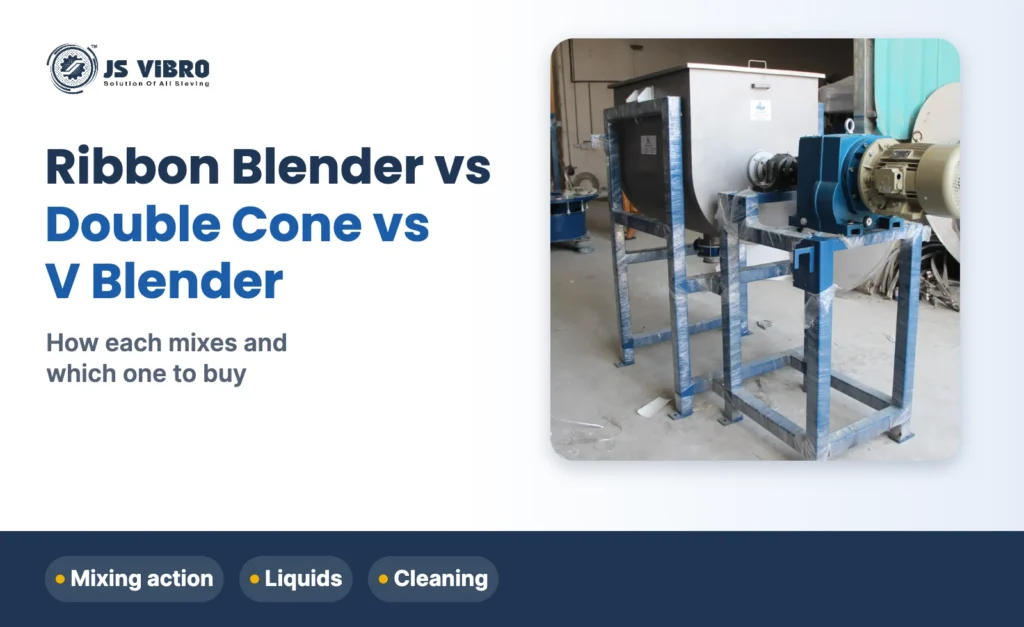
A ribbon blender mixes with an inner and outer helical ribbon turning inside a fixed U-trough; it handles cohesive powders, can add liquids through a spray bar and suits large batches. Double cone and V blenders are tumble blenders: the whole vessel rotates and the powder folds over itself. They are gentle on free-flowing granules and easy to clean, but struggle with sticky powders and liquid addition.
Below is how each mixes, a comparison table and which to choose. For ribbon blender sizes and prices, see our ribbon blender manufacturer page.
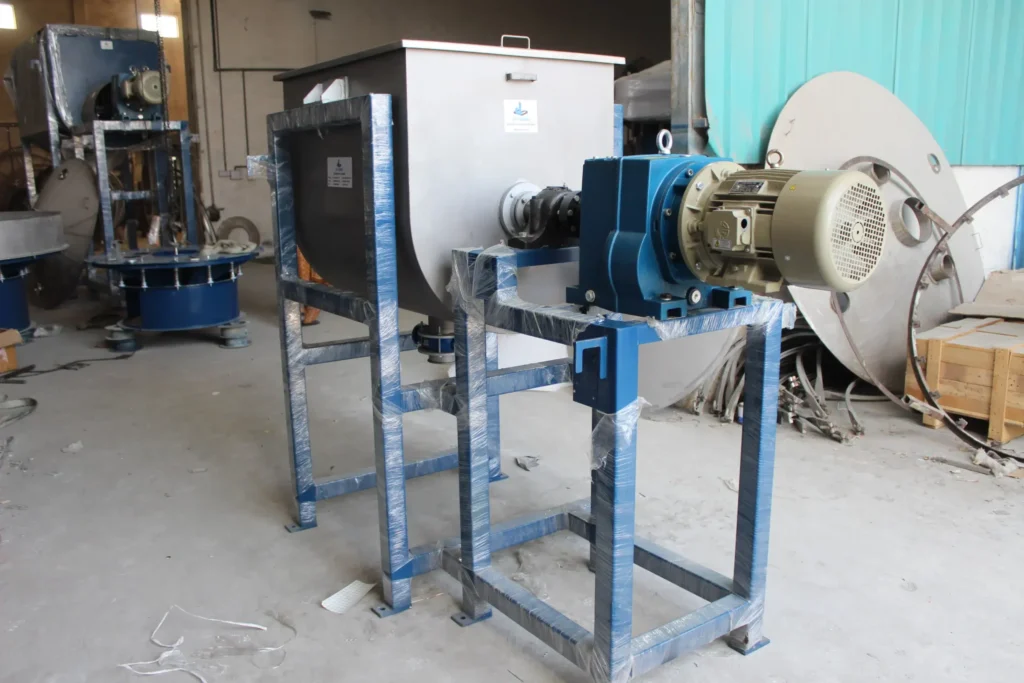
How a ribbon blender mixes
The outer ribbon moves material one way along the trough while the inner ribbon moves it back the other way. This counter-current flow, plus movement from the walls to the centre, mixes powders quickly, usually in 10–20 minutes. Read the basics in what is a ribbon blender and how does it work.
How double cone and V blenders mix
The vessel itself turns slowly. Powder tumbles, splits and recombines on every turn. There is no agitator touching the product, so mixing is gentle. V blenders split the powder into two arms each turn; double cones roll it between two cones.
Comparison
| Ribbon blender | Double cone blender | V blender | |
|---|---|---|---|
| Mixing action | Convective (ribbons move powder) | Tumbling | Tumbling and splitting |
| Cohesive or sticky powders | Good | Poor | Poor to fair |
| Adding liquids | Yes, with a spray bar | Limited | Limited (with an intensifier bar) |
| Gentleness on granules | Moderate | High | High |
| Typical mixing time | 10–20 minutes | Longer | Longer |
| Cleaning | Shaft, ribbons and seals to clean | Easy: no internal parts | Easy: no internal parts |
| Typical batch | 50 kg to 10 ton | Small to medium | Small to medium |
| Common uses | Food, chemicals, building materials, detergents, pharma premixes | Pharma granule lubrication | Pharma and food dry blends |
Which should you choose?
- Large batches, cohesive powders or liquid addition: a ribbon blender.
- Gentle blending of free-flowing pharma granules with lubricant: a double cone or V blender.
- Several recipes a day with strict cleaning: tumble blenders are easier to clean; a ribbon blender with a polished finish and good access also works.
Pharma use
Many pharma plants use both: tumble blenders for final lubrication and ribbon blenders for premixes and larger batches. See ribbon blender applications in pharma.
Getting the size right
Whichever you choose, size it by volume, not weight. The ribbon blender capacity guide shows how.
Frequently asked questions
What is the difference between a ribbon blender and a double cone blender?
A ribbon blender mixes with rotating ribbons inside a fixed trough; a double cone blender rotates the whole vessel to tumble the powder.
Which blender is best for sticky powders?
A ribbon blender, because the ribbons move material that would not tumble freely.
Can I add liquid in a V blender?
Only in limited amounts, usually with an intensifier bar. A ribbon blender with a spray bar handles liquid addition better.
Which blender is easiest to clean?
Double cone and V blenders, because they have no agitator inside.
Which is faster?
A ribbon blender usually mixes in 10–20 minutes, faster than tumble blenders for most powders.


