

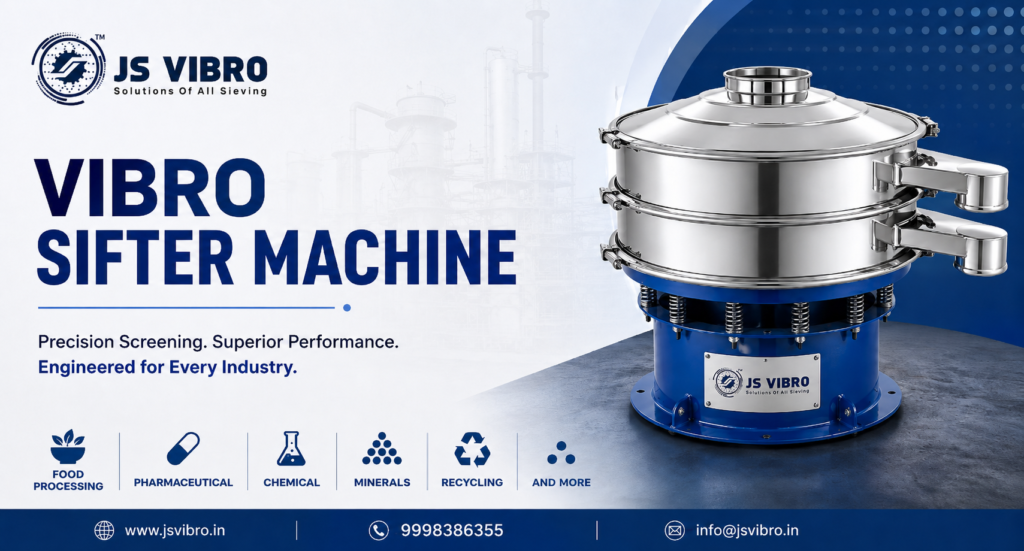
If your production line handles powders, granules, or slurries, accurate particle separation is not optional — it is a quality mandate. A Vibro Sifter machine is one of the most efficient, reliable, and widely trusted solutions for industrial sieving across dozens of sectors. In this guide, we cover everything you need to know about Vibro Sifter machines — how they work, where they are used, and why choosing the right Vibro Sifter machine manufacturer matters more than you might think.
What is a Vibro Sifter machine?
A Vibro Sifter machine — also known as a vibratory separator, gyro sifter, or circular separator — is a mechanical screening device that uses controlled three-dimensional vibratory motion to separate materials by particle size. The machine consists of a vibrating motor mounted below or above a circular sieve body, a woven wire mesh of specified aperture, and discharge outlets for separated fractions.
When material is fed onto the sieve surface, vibration causes fine particles to pass through the mesh while oversize particles travel outward and discharge through a tangential outlet. This process is continuous, requiring no manual intervention, and can handle both dry and wet materials.
Industries that rely on Vibro Sifter machines
Vibro Sifter machines serve a broad industrial landscape. Some of the most common applications include:
- Pharmaceutical — sieving of API powders, excipients, and granules for uniformity and contamination control
- Food processing — grading spices, flour, sugar, salt, and dry dairy powders
- Chemical industry — separating pigments, resins, fertilisers, and specialty chemicals
- Cosmetics — screening talc, mica, starch, and colour pigments
- Ceramics and minerals — classifying clay, silica, calcium carbonate, and metal powders
- Polymer and plastics — sieving plastic granules and powder blends
- Paint and coatings — removing oversized particles to ensure smooth dispersion
Not all Vibro Sifter machines deliver the same performance. The quality of welding, motor selection, mesh tensioning, and surface finish directly affects sieving accuracy, machine lifespan, and ease of cleaning. A reputable Vibro Sifter machine manufacturer will offer material traceability, calibration documentation, and compliance with GMP or food-grade standards where required.
Before purchasing, ask your manufacturer about motor warranty, mesh replacement ease, cGMP documentation support, and after-sales service availability in your region. These factors are often more important than the base machine price in the long run.
How to select the right Vibro Sifter machine
Why the manufacturer you choose matters
Choosing the correct Vibro Sifter machine involves evaluating several parameters specific to your material and production requirements:
- Material characteristics — bulk density, particle size distribution, moisture content, and flowability
- Required throughput — kilograms or tonnes per hour determines the screen diameter needed
- Separation cut point — the mesh size in microns or BSS mesh number
- Number of fractions — single, double, or triple deck configuration
- Compliance requirements — GMP, FDA, ATEX, or food-grade certification
- Wet or dry application — wet sieving requires liquid ports and EPDM/silicone seals


