

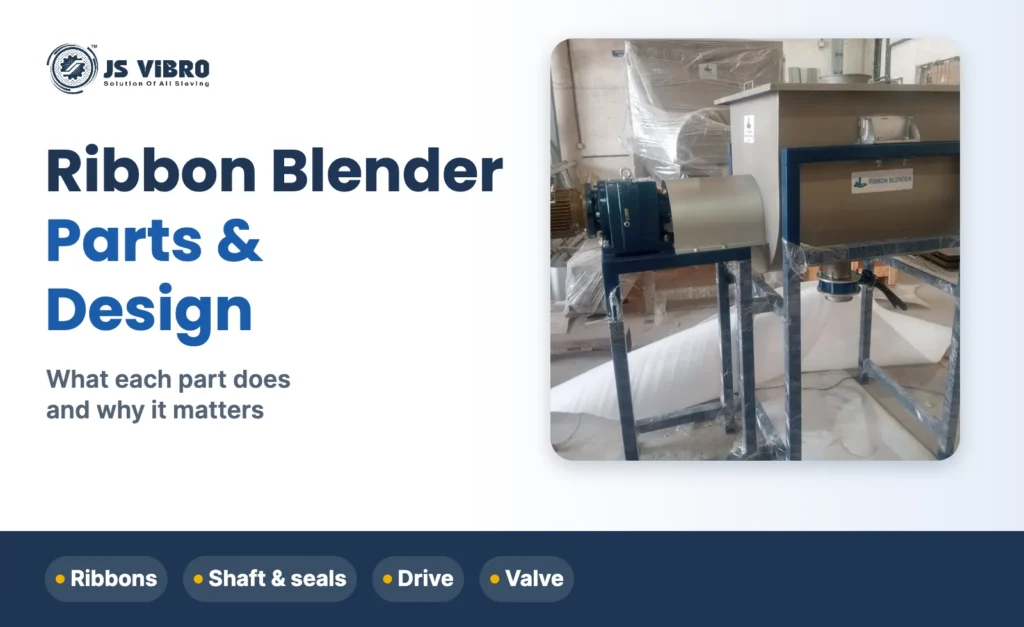
A ribbon blender has six main parts: a U-shaped trough, a shaft carrying an inner and an outer helical ribbon, end bearings and shaft seals, a drive (motor and gearbox), a discharge valve at the bottom, and a top cover with loading ports. Options include a spray bar for liquids and a jacket for heating or cooling.
Here is what each part does and what to check when you compare machines. For full specifications, see our ribbon blender mixer page.
1. U-trough
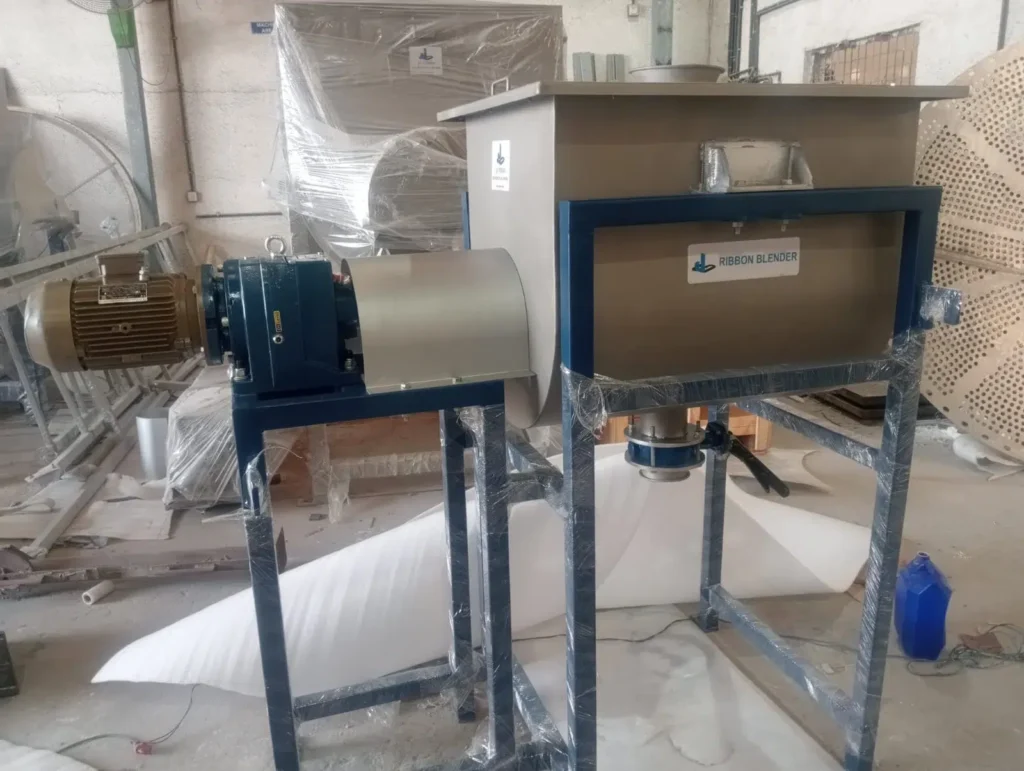
The trough holds the batch. Its U shape matches the ribbons, so material near the wall is always moved. Trough volume sets the batch size; see the capacity guide. Contact surfaces are SS 304 or SS 316.
2. Inner and outer ribbons
The outer ribbon pushes material along the trough one way; the inner ribbon pushes it back the other way. This counter-flow, plus movement between the wall and the centre, gives a fast, even mix. The gap between the outer ribbon and the trough is kept small so little material is left unmixed at the wall.
3. Shaft, bearings and seals
The ribbons are welded to a central shaft supported by bearings outside the trough at each end. Seals (gland packing or mechanical seals) stop powder leaking out and lubricant getting in. Seal type matters for hygiene and for fine powders.
4. Drive
A motor and gearbox turn the shaft at a slow, steady speed. Larger batches and denser products need more power. A VFD lets you adjust speed for different products.
5. Discharge valve
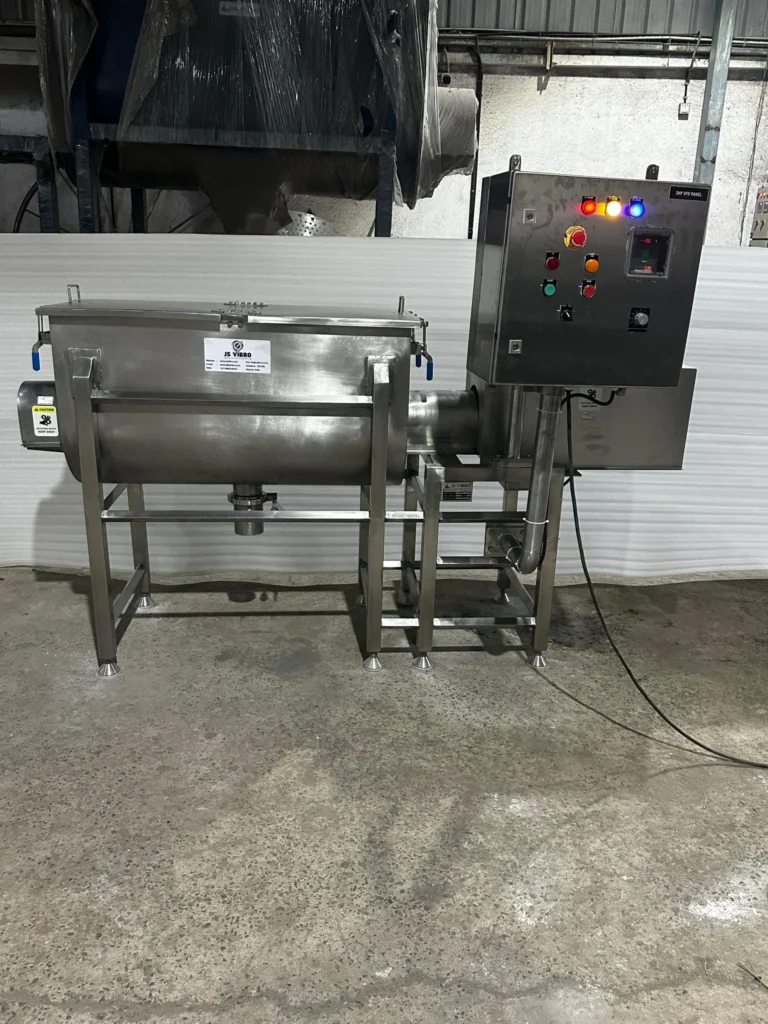
The valve at the centre of the trough bottom empties the batch. Types include manual slide valves, pneumatic butterfly or slide valves, and flush-bottom valves that leave no dead space. A good valve seals tightly during mixing and opens fully for fast discharge.
6. Top cover
The cover keeps dust in and has loading ports, inspection windows or a hinged lid for cleaning. Safety interlocks stop the ribbons when the cover is opened.
Options
| Option | What it does |
|---|---|
| Spray bar | Adds oil, binder or water evenly during mixing |
| Jacket | Heats or cools the batch with water, steam or thermic oil |
| Choppers | High-speed blades that break lumps (on some designs) |
| Load cells | Weigh the batch in the blender |
| GMP finish | Polished, crevice-free surfaces for pharma and food |
For the basics of how these parts work together, read what is a ribbon blender and how does it work.
Frequently asked questions
What are the main parts of a ribbon blender?
The U-trough, the shaft with inner and outer ribbons, bearings and seals, the drive, the discharge valve and the top cover.
Why do ribbon blenders have two ribbons?
The outer and inner ribbons push material in opposite directions, which mixes it quickly and evenly.
What type of discharge valve should I choose?
Manual slide valves suit simple jobs; pneumatic or flush-bottom valves give faster, cleaner discharge and suit pharma and food.
What is a spray bar used for?
To add liquids such as oil, binder or water evenly while the blender runs.
Why fit a jacket?
To heat or cool the batch during mixing.


