

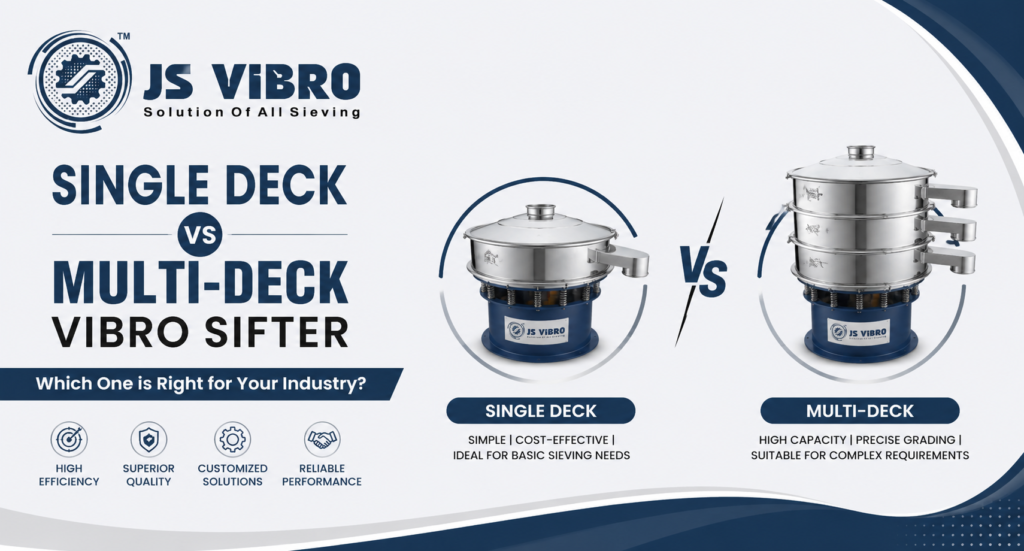
A Vibro Sifter is an important screening machine used for separating, grading, and removing unwanted particles from powders, granules, and other materials. It is widely used in industries such as pharmaceuticals, food processing, chemicals, cosmetics, nutraceuticals, and industrial manufacturing. The machine works through controlled vibration, where material is fed onto a mesh screen and separated based on particle size. Smaller particles pass through the mesh, while oversized particles remain on the screen and move toward the discharge outlet.
When buying a Vibro Sifter, one of the most common questions is whether to choose a single deck Vibro Sifter or a multi-deck Vibro Sifter. Both machines are useful, but they are designed for different screening needs. A single deck model is simple and suitable for basic separation, while a multi-deck model is used when material needs to be separated into multiple sizes or grades in one process. Understanding the difference between these two options can help you select the right machine for your production line.
What Is a Single Deck Vibro Sifter?
A single deck Vibro Sifter has one screening layer or one mesh screen. It is mainly used when the material needs one level of separation. For example, if you want to remove oversized particles from powder or separate fine particles from coarse material, a single deck sifter can be a practical choice.
In this machine, material is fed from the top. The vibration moves the material across the screen. Particles smaller than the mesh opening pass through the screen, while larger particles stay on the screen and move toward the outlet. This makes the single deck model useful for simple sieving and quality control.
A single deck Vibro Sifter is commonly used in small and medium production setups. It is also preferred when the process does not require multiple particle size classifications. Because the design is simple, it is easier to operate, clean, inspect, and maintain. Single deck vibrating screens are often valued for their lower cost and lower maintenance needs compared with more complex multi-deck systems.
What Is a Multi-Deck Vibro Sifter?
A multi-deck Vibro Sifter has two or more screening layers. Each deck has a different mesh size, allowing the machine to separate material into multiple grades in one operation. For example, a double deck machine can separate material into different particle size groups through two screens and multiple discharge outlets. Some multi-deck machines are designed to classify material into several size fractions in a single process.
The main benefit of a multi-deck Vibro Sifter is that it saves time and space when more than one level of separation is needed. Instead of using multiple single deck machines, a manufacturer can use one multi-deck machine to perform several separations at the same time.
This type of sifter is useful for industries that need accurate grading. For example, food companies may use it to classify granules or powders into different sizes. Chemical manufacturers may use it to separate powders into multiple grades. Pharmaceutical companies may use it when particle size consistency is important for production quality.
Working Principle of Single Deck and Multi-Deck Vibro Sifter
Both single deck and multi-deck Vibro Sifters work on the same basic principle: vibration and mesh-based separation. The machine creates vibration through a motor, which moves the material across the screen. The screen allows particles smaller than the mesh size to pass through, while larger particles remain above the screen. This size-based separation helps remove lumps, foreign particles, oversized material, or unwanted particles from the final product.
The difference is in the number of screening stages. In a single deck model, the material passes through one screen. In a multi-deck model, material can pass through two or more screens. Larger particles may remain on the top deck, medium particles may be collected from another level, and finer particles may pass through to the lower deck. This allows the machine to create multiple output grades from one material flow.
Key Difference Between Single Deck and Multi-Deck Vibro Sifter
The biggest difference is the number of screens. A single deck Vibro Sifter has one screen, while a multi-deck Vibro Sifter has multiple screens. This difference affects output, cost, cleaning time, maintenance, machine size, and application.
A single deck machine is suitable for simple screening. It is easier to use and is often more affordable. It is a good option when you only need to remove oversized particles or perform one separation step.
A multi-deck machine is suitable for complex screening. It can separate one material into different particle sizes in a single operation. This makes it useful for industries that need multiple final grades. However, it may cost more and may take more time to clean and maintain because there are more screens and parts.
Advantages of Single Deck Vibro Sifter
The first advantage of a single deck Vibro Sifter is simplicity. Since it has only one screening deck, operators can learn to use it quickly. It is easy to inspect, easy to clean, and easy to maintain.
The second advantage is cost-effectiveness. A single deck machine usually has a lower initial cost than a multi-deck model. For small businesses or companies with basic screening needs, this can be a smart investment.
The third advantage is faster cleaning. In industries such as food and pharmaceuticals, cleaning between batches is very important. A single deck machine has fewer parts, so cleaning and screen replacement can be completed more quickly.
The fourth advantage is suitability for basic applications. If your process only needs one output separation, a single deck Vibro Sifter may be enough. For example, if you only want to remove coarse particles from powder, there may be no need to invest in a multi-deck model.
Limitations of Single Deck Vibro Sifter
The main limitation of a single deck Vibro Sifter is that it can only perform one level of separation at a time. If you need to divide material into multiple size grades, one single deck machine may not be enough.
In some cases, businesses use multiple single deck machines for different screening stages. However, this can take more floor space and increase handling time. A recent vibrating-screen comparison notes that using multiple single deck screens to match the separation of a multi-deck system may require more space, supports, and walkways.
Another limitation is lower flexibility for advanced grading. If your industry requires fine, medium, and coarse grades from the same batch, a single deck model may slow down the process.
Advantages of Multi-Deck Vibro Sifter
The biggest advantage of a multi-deck Vibro Sifter is multi-size separation. It can classify material into different particle sizes in one process. This improves workflow and reduces the need for multiple machines.
Another benefit is space saving. Instead of installing two or three separate machines, a company can use one multi-deck machine. This is helpful when the production area has limited floor space.
A multi-deck Vibro Sifter can also improve production efficiency. Since multiple separations happen in one operation, material handling becomes easier. It can also reduce processing time in applications where several grades are required.
This machine is especially useful for industries that need accuracy and consistency. For example, in food processing, particle size can affect texture, mixing quality, and final product appearance. In chemicals, particle size can affect performance and blending. In pharmaceuticals, consistent particle size can support better processing and quality control.
Limitations of Multi-Deck Vibro Sifter
A multi-deck Vibro Sifter is more complex than a single deck model. It has more screens, more discharge points, and more parts to inspect. This means cleaning and maintenance can take more time.
The initial cost is also higher. If your process only needs simple screening, investing in a multi-deck model may not be necessary. It is important to match the machine with your actual production requirement instead of choosing a bigger or more complex machine without need.
Another limitation is that proper setup is important. Mesh size selection, material feeding rate, vibration setting, and deck arrangement must be correct. If the machine is not properly configured, screening efficiency may decrease. In multi-deck systems, the relationship between screen openings on different decks can affect separation performance.
Application-Wise Comparison
For the pharmaceutical industry, both types can be useful. A single deck Vibro Sifter is suitable for simple powder screening and oversized particle removal. A multi-deck model is better when the material must be separated into multiple particle sizes. Hygiene, stainless-steel construction, and easy cleaning are important in both cases.
For the food processing industry, a single deck model can be used for flour, spices, sugar, and powder screening when only one separation is required. A multi-deck model is better for grading food ingredients into different sizes.
For the chemical industry, the choice depends on the material and required output. If the goal is only to remove lumps or unwanted particles, a single deck sifter may work well. If the chemical powder needs multiple grades, a multi-deck sifter is more suitable.
For cosmetics and nutraceuticals, fine powder quality is often important. A single deck machine can support basic sieving, while a multi-deck machine can help with more precise classification.
Cost Comparison
Single deck Vibro Sifters are usually more affordable because they have a simpler design. They require fewer screens and components. Maintenance costs may also be lower because fewer parts need replacement.
Multi-deck Vibro Sifters generally cost more due to their advanced design and multiple screening layers. However, they may provide better long-term value if your process requires multiple separations. Instead of buying several single deck machines, one multi-deck machine may complete the work more efficiently.
So, the best decision is not always based on the lowest price. It should be based on your production need, output requirement, available space, cleaning process, and future expansion plans.
Maintenance and Cleaning Comparison
Maintenance is easier in a single deck Vibro Sifter because there is only one screen. Operators can inspect the mesh, gasket, clamp, and discharge area quickly. This is helpful when frequent product changeovers are required.
A multi-deck Vibro Sifter takes more time to clean because it has multiple screens and discharge sections. However, if it is designed well, cleaning can still be manageable. When buying a multi-deck model, always check whether the machine has easy dismantling, smooth internal surfaces, and simple screen replacement.
In industries where hygiene is critical, cleaning time can directly affect production planning. So, the machine should be selected not only for output but also for ease of cleaning.
Which Vibro Sifter Should You Choose?
You should choose a single deck Vibro Sifter if your process needs simple separation, low to medium production, easy cleaning, lower investment, and basic quality control. It is ideal when one mesh screen is enough to meet your requirement.
You should choose a multi-deck Vibro Sifter if your process needs multiple particle size grades, higher screening efficiency for complex applications, reduced floor space, and faster multi-stage separation. It is ideal when you need two or more screening levels in one machine.
Before finalising the machine, discuss your material details with the manufacturer. Share information such as material type, bulk density, moisture level, particle size range, required output, mesh size, and industry standards. A reliable Vibro Sifter Machine Manufacturer can help you choose the right deck design based on your actual production needs.


