

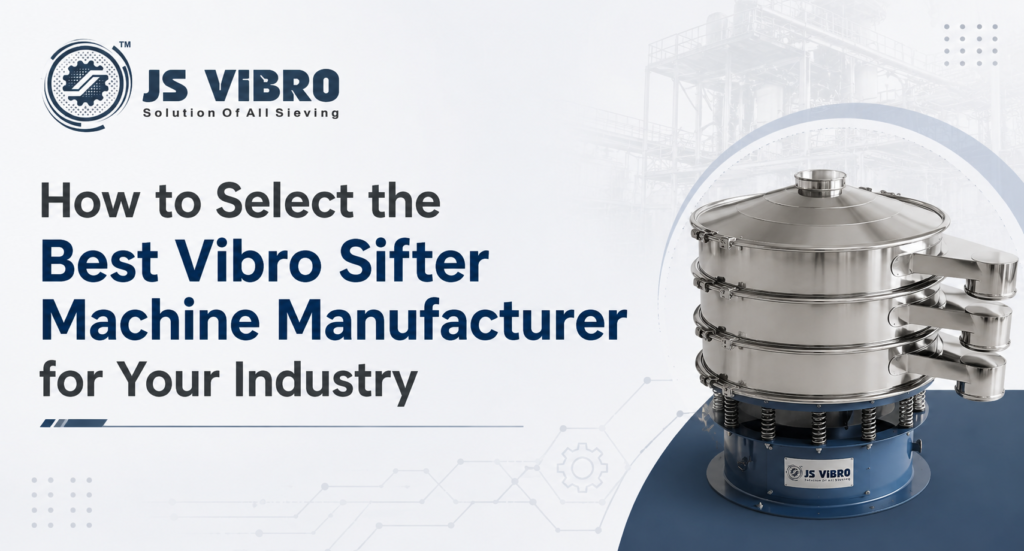
Choosing the right Vibro Sifter Machine Manufacturer is an important decision for any business that deals with powders, granules, or solid material separation. A vibro sifter machine is widely used for sieving, grading, separating, and removing unwanted particles from materials. It is commonly used in industries such as pharmaceuticals, food processing, chemicals, cosmetics, nutraceuticals, and other manufacturing sectors. Many vibro sifter machines work through controlled vibration, where material moves across a screen or mesh to separate particles according to size. This makes the machine useful for improving product consistency, quality, and production efficiency.
However, not every vibro sifter machine is suitable for every industry. A pharmaceutical company may need a hygienic, GMP-compliant stainless-steel machine, while a chemical manufacturer may need a stronger machine designed for heavy-duty material handling. Similarly, a food processing company may focus more on easy cleaning, contamination control, and food-grade contact parts. That is why selecting the right manufacturer is just as important as selecting the machine itself.
A good manufacturer does not only sell machinery. They understand your production needs, material type, capacity requirements, quality standards, safety needs, and long-term maintenance expectations. This guide will help you understand how to select the best vibro sifter machine manufacturer for your industry.
Understand Your Industry Requirements First
Before contacting any manufacturer, you should clearly understand your own industry requirements. Vibro sifter machines are used in different industries for different purposes. In the pharmaceutical industry, they are commonly used for powder and granule screening, particle size separation, and foreign particle removal. In food processing, they can be used for flour, spices, sugar, milk powder, and other food ingredients. In chemical industries, they help separate powders, pigments, resins, and other raw materials.
Every industry has different expectations. For example, pharmaceutical and food industries often need hygienic design, stainless-steel construction, smooth finishing, and easy dismantling for cleaning. Chemical and industrial sectors may need machines with higher capacity, strong vibration, corrosion-resistant parts, or flame-proof motor options depending on the material being processed.
When you know your industry needs clearly, it becomes easier to explain your requirements to the manufacturer. You should know what material you want to screen, whether it is dry or wet, fine or coarse, sticky or free-flowing, and how much output you need per hour. These details help the manufacturer suggest the right model, mesh size, deck design, and motor capacity.
Evaluate Machine Quality and Material Construction
The quality of the vibro sifter machine depends largely on its construction material, design, finishing, and engineering accuracy. Stainless steel is commonly preferred for industries where hygiene, durability, and corrosion resistance are important. Many manufacturers offer machines with SS 304 or SS 316 contact parts, depending on the application. GMP-compliant stainless-steel construction is especially important for pharmaceutical and food applications.
You should ask the manufacturer about the grade of stainless steel used in contact and non-contact parts. Contact parts are the areas that directly touch the material being processed. For sensitive products, these parts should be smooth, easy to clean, and resistant to contamination. Poor-quality material can lead to rusting, product contamination, frequent breakdowns, and higher maintenance costs.
Also check the overall build quality. A good vibro sifter should have a strong base, stable vibration system, proper clamping arrangement, accurate sieve fitting, and smooth discharge flow. The machine should be designed to handle continuous operation without unnecessary noise, vibration imbalance, or frequent downtime.
Look for GMP and Hygiene Standards
If your industry requires hygiene and product safety, you should choose a manufacturer that follows GMP-friendly design principles. GMP stands for Good Manufacturing Practice, and it is especially important in pharmaceutical, food, nutraceutical, and cosmetic production. A GMP-compliant vibro sifter usually has smooth surfaces, stainless-steel contact parts, easy cleaning design, and reduced areas where material can accumulate.
Hygiene is not only about cleaning the machine from the outside. The internal design should also allow easy dismantling and inspection. The sieve, gasket, hopper, and discharge parts should be easy to remove and clean. This is especially important when the same machine is used for different batches or different products.
A machine that is difficult to clean can increase production downtime and may also increase the risk of cross-contamination. Therefore, always ask the manufacturer about cleaning procedure, dismantling time, gasket quality, surface finish, and whether the machine is suitable for your hygiene standards.
Review Technical Specifications Carefully
Technical specifications are the backbone of machine selection. You should never buy a vibro sifter machine only by looking at its price or outer appearance. Important specifications include sieve diameter, mesh size, number of decks, motor power, vibration pattern, capacity, voltage, machine dimensions, material of construction, discharge height, and automation level.
The mesh size is especially important because it decides the particle size separation. Fine powders require different mesh sizes compared to coarse granules. Some applications may require multiple decks to separate material into different grades. A single deck vibro sifter may be suitable for simple screening, while a double deck or multi deck machine may be required for more accurate classification.
Capacity is another important factor. You should ask the manufacturer how much material the machine can process per hour. But remember that actual capacity depends on the material type, bulk density, moisture level, mesh size, and flow behaviour. A genuine manufacturer will explain these factors instead of giving unrealistic capacity claims.
Check Customisation Options
Every production process is different, so customisation is often necessary. A reliable vibro sifter machine manufacturer should be able to customise the machine according to your requirements. Customisation may include machine diameter, deck arrangement, mesh size, inlet and outlet position, contact material, motor type, trolley-mounted design, flame-proof motor, dust cover, inspection window, or integration with existing production lines.
For example, if your material is very fine, you may need a special screen arrangement. If your production area has limited space, you may need a compact design. If your process requires dust-free operation, you may need a covered design with proper sealing. For sticky or difficult materials, some manufacturers may recommend additional features or special screening systems.
Customisation shows that the manufacturer understands industrial requirements instead of offering one-size-fits-all machinery. It also helps you get better performance, lower wastage, and smoother production.
Consider After-Sales Support and Spare Parts Availability
A vibro sifter machine is a long-term investment. Even a high-quality machine needs proper maintenance, spare parts, and technical support over time. That is why after-sales service should be a major part of your selection process.
Before finalising a manufacturer, ask about installation support, operator guidance, spare parts availability, warranty, maintenance service, and technical assistance. Important spare parts may include mesh screens, gaskets, clamps, springs, motor parts, and rubber components. If spare parts are not easily available, even a small issue can stop your production for days.
A good manufacturer provides clear support after the sale. They should help you with installation, troubleshooting, maintenance instructions, and replacement parts. Strong after-sales support reduces downtime and improves the life of the machine.
Compare Price with Long-Term Value
Price is important, but it should not be the only deciding factor. Many buyers make the mistake of choosing the cheapest vibro sifter machine and later face problems such as low output, poor separation, high vibration noise, frequent maintenance, poor material quality, and lack of support.
Instead of only comparing price, compare value. A slightly higher-priced machine from a trusted manufacturer may offer better stainless steel, stronger motor, better finishing, longer life, smoother operation, and reliable service. This can save money in the long run by reducing maintenance cost, production loss, and product rejection.
Ask for a detailed quotation that includes machine specifications, material grade, motor details, accessories, warranty, delivery time, taxes, and installation support. This will help you compare manufacturers properly.
Check Reputation and Customer Feedback
A manufacturer’s reputation gives you a good idea of their reliability. Check their website, client list, product range, customer reviews, certifications, and market presence. If possible, ask for references or case studies from customers in your industry.
You can also check whether the manufacturer exports machines, offers product documentation, provides quality certificates, or follows standard manufacturing processes. A manufacturer with a strong reputation is more likely to provide consistent product quality and dependable service.
Do not hesitate to ask questions. A professional manufacturer will answer your questions clearly and guide you honestly. If a supplier avoids technical questions or gives vague answers, it may be better to look for another option.
Ask the Right Questions Before Buying
Before placing an order, ask the manufacturer a few important questions. What material can the machine handle? What is the recommended mesh size for your product? What is the hourly output capacity? Is the machine suitable for dry or wet screening? What grade of stainless steel is used? Can the machine be customised? Is the motor flame-proof if required? How easy is it to clean and maintain? What spare parts are available? What warranty is provided?
These questions help you understand whether the manufacturer is technically capable and transparent. They also help you avoid wrong machine selection.
Common Mistakes to Avoid
Before placing an order, ask the manufacturer a few important questions. What material can the machine handle? What is the recommended mesh size for your product? What is the hourly output capacity? Is the machine suitable for dry or wet screening? What grade of stainless steel is used? Can the machine be customised? Is the motor flame-proof if required? How easy is it to clean and maintain? What spare parts are available? What warranty is provided?
These questions help you understand whether the manufacturer is technically capable and transparent. They also help you avoid wrong machine selection.


