

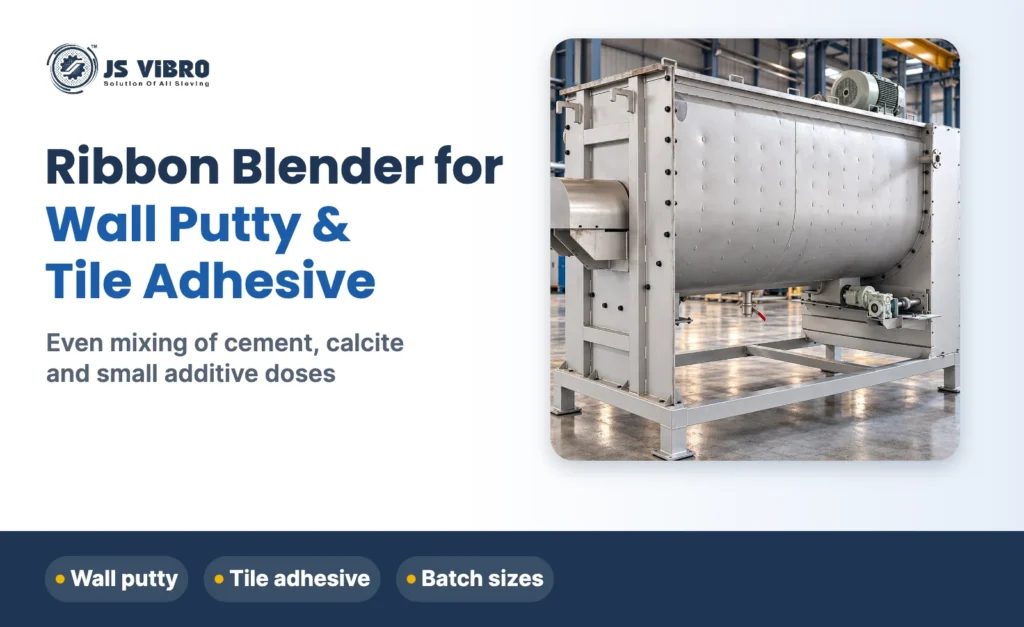
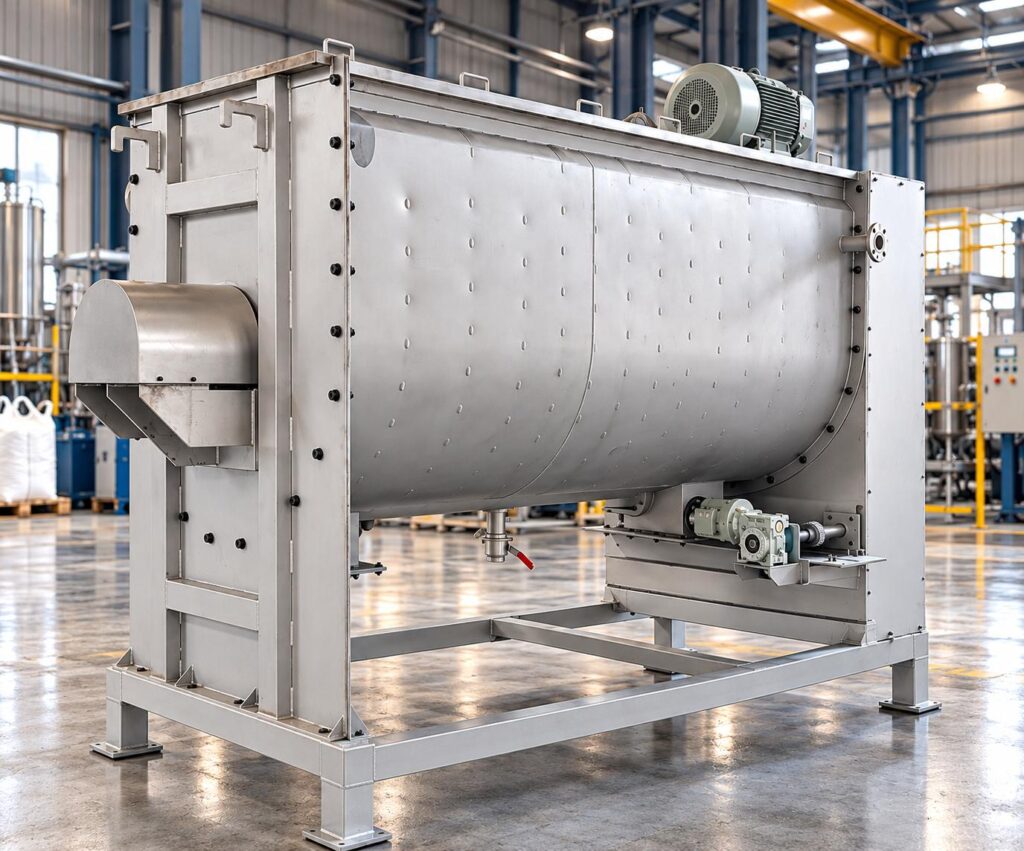
Wall putty and tile adhesive are dry mixes of white or grey cement, fine fillers such as calcite, and small doses of additives such as cellulose ethers and polymer powders. A ribbon blender suits them because it spreads those small additions evenly through large batches in a short cycle, and the blend discharges straight to packing.
Below is what goes into these products, what to look for in a blender and typical batch sizes. JS Vibro builds the ribbon blender machine for building-material plants across Gujarat and India.
What goes into wall putty and tile adhesive
| Ingredient | Role |
|---|---|
| White or grey cement | Binder |
| Calcite or other fine fillers | Bulk and smoothness |
| Cellulose ether (small dose) | Water retention and workability |
| Redispersible polymer powder (small dose) | Adhesion and flexibility |
| Other additives | Set control, anti-sag, as the formula requires |
Why small doses need a good mixer
Additives are often well under 1% of the batch, yet they decide how the product performs on the wall. If they are not spread evenly, one bag works and the next does not. The counter-flow of the inner and outer ribbons moves every part of the batch, so small doses reach all of it. Pre-mixing additives with some filler before loading helps further.
What to specify
- Construction: MS or SS; calcite and cement are abrasive, so ask about wear on the ribbons and trough.
- Discharge valve: large, fast-opening, to empty quickly into the packing hopper.
- Dust control: sealed cover and a dust-extraction point at loading.
- Drive: sized for dense blends (about 0.9–1.1 kg/L).
Batch sizes
Plants commonly run 500 kg to 2 ton batches. Size the blender by volume using bulk density; the capacity guide has a worked example for 1 ton of wall putty.
A typical line
- Raw materials weighed and loaded (bag tip or screw conveyor)
- Additives pre-mixed and added
- Ribbon blender mixes the batch
- Discharge to a hopper over the packing machine
- Bags packed and sealed
A screw conveyor can feed the blender and take the blend to packing.
Price
See ribbon blender machine price in India for prices by batch size.
Frequently asked questions
Can a ribbon blender be used for wall putty?
Yes. It mixes cement, calcite and small additive doses evenly in large batches.
What batch size is common for wall putty plants?
Often 500 kg to 2 ton per batch, depending on output.
Is MS or SS used for wall putty blenders?
Either can be used; ask about wear protection because calcite and cement are abrasive.
How do I make sure additives mix evenly?
Pre-mix them with some filler, load them in the middle of the batch and mix for the validated time.
Can the same blender make tile adhesive?
Yes, with cleaning between products if formulas differ.


