
Horizontal Screw Conveyor Machine Manufacturer
What is a Horizontal Screw Conveyor?
A horizontal screw conveyor is a type of auger conveyor that uses a rotating helical screw blade (called a flight) inside a trough or tube to move materials horizontally.
This system is specifically designed for horizontal or near-horizontal transportation of bulk materials. It ensures continuous movement from the inlet to the discharge point with minimal spillage and dust emission.
Screw conveyors are widely used because they are capable of handling both free-flowing and sluggish materials efficiently.
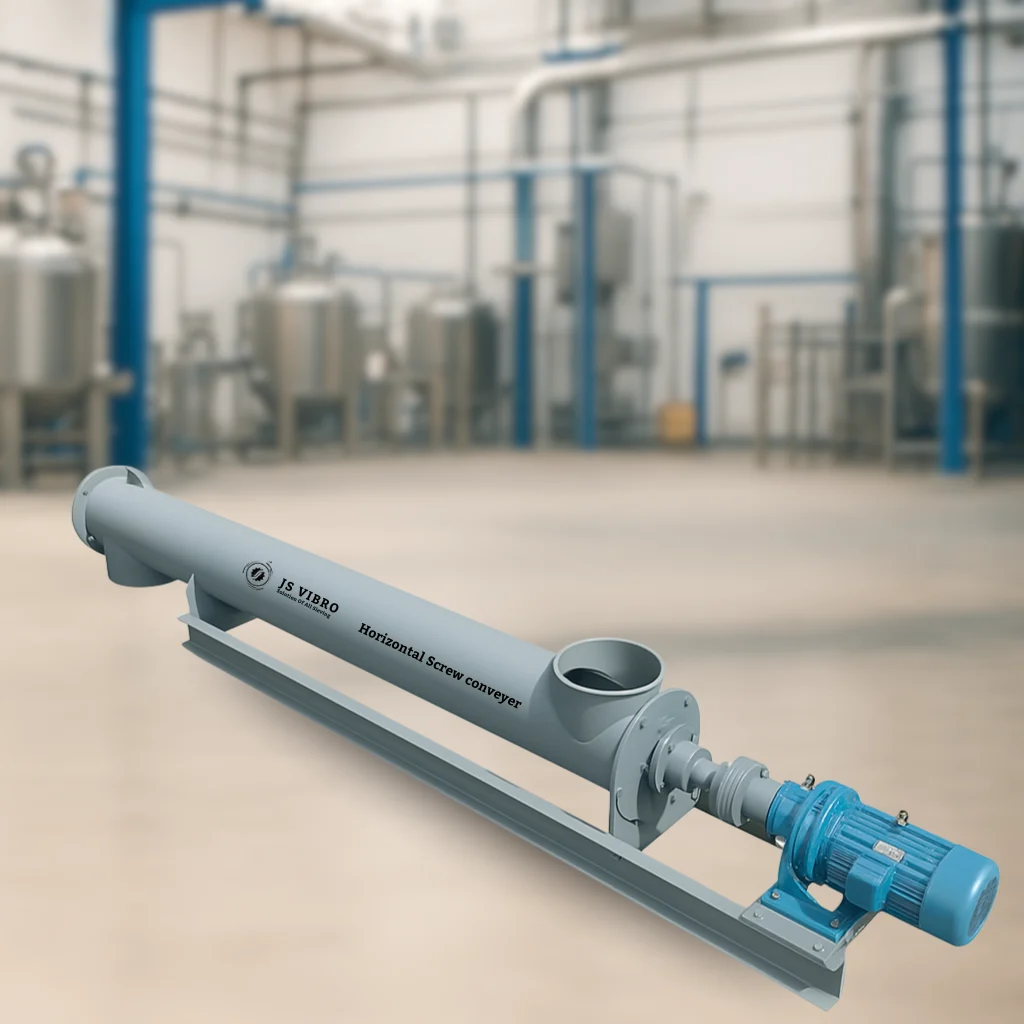
Horizontal Screw Conveyor - Working Principle
The working principle of a horizontal screw conveyor is based on rotational motion converting into linear movement.
Inside the conveyor, a motor drives the screw shaft, causing the helical blade to rotate. As the screw rotates, it pushes the material forward along the trough. The material does not rotate with the blade due to friction and gravity, allowing it to move steadily toward the discharge end.
This mechanism ensures:
- Continuous material flow
- Controlled feed rate
- Efficient transfer over distances
The capacity of the conveyor depends on factors like screw diameter, pitch, speed (RPM), and material characteristics.
Features & Benefits Horizontal screw conveyor
- Efficient linear transfer ensures smooth and continuous movement of bulk materials.
- Closed, dust-free design prevents contamination and material spillage.
- Customizable length and diameter options to match plant layout and required flow rate.
- Robust MS or SS304/316 construction suitable for abrasive, sticky, or hygienic materials.
- Low maintenance design with minimal wear and easy component access.
- Easy integration with feeders, mixers, and silos for seamless operation.
- Variable speed drive option allows adjustable flow for precise process control.
- Versatile use suitable for powders, grains, food ingredients, chemicals, and more.
Key Components of Horizontal Screw Conveyor
The working principle of a horizontal screw conveyor is based on rotational motion converting into linear movement.
Inside the conveyor, a motor drives the screw shaft, causing the helical blade to rotate. As the screw rotates, it pushes the material forward along the trough. The material does not rotate with the blade due to friction and gravity, allowing it to move steadily toward the discharge end.
This mechanism ensures:
- Continuous material flow
- Controlled feed rate
- Efficient transfer over distances
The capacity of the conveyor depends on factors like screw diameter, pitch, speed (RPM), and material characteristics.
Advantages of Horizontal Screw Conveyor
- Cost-effective solution compared to pneumatic or belt conveyors
- Fully enclosed system prevents dust and material spillage
- Low maintenance and simple design
- Flexible installation options
- Handles a wide range of materials (powder, grains, sludge, cement)
- Multiple inlet and discharge points for efficient distribution
