

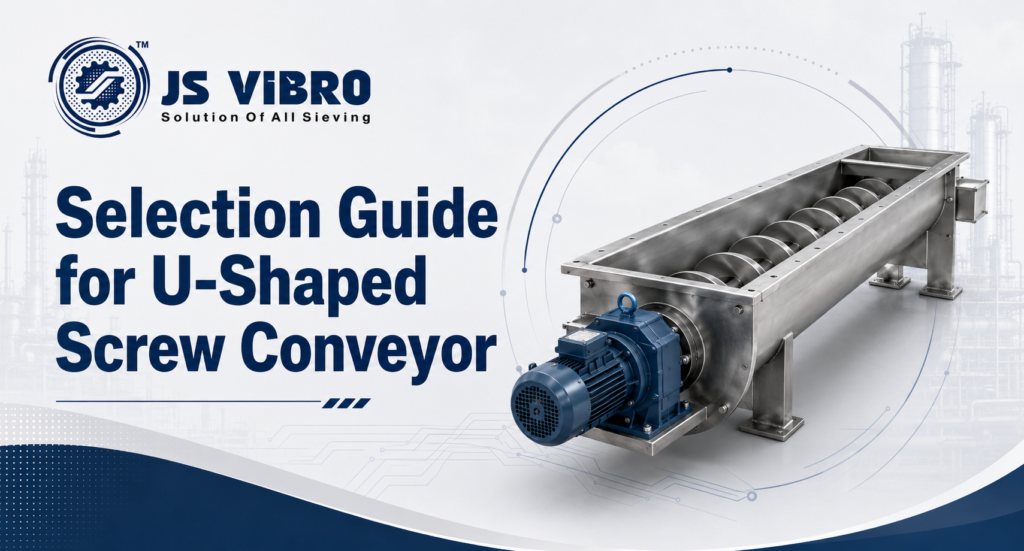
Choosing the right U-shaped screw conveyor is important for smooth, safe, and efficient material handling. The correct model depends on the type of material, required conveying capacity, working environment, conveying distance, and construction material.
A U-shaped screw conveyor is commonly used for transporting powder, small granules, and small block materials. It is suitable for industries that need enclosed conveying, dust control, and stable material movement. However, it is not ideal for sticky, wet, perishable, or easily agglomerated materials, as these can block the conveyor or reduce performance
1. Consider the Required Conveying Capacity
The first factor in selecting a U-shaped screw conveyor is the required output. If the production demand is high, a larger conveyor model is needed. Common models include U200, U250, U300, U400, U500, and U600. The higher the conveying capacity, the larger the conveyor size should be.
Before purchasing, users should clearly calculate how much material needs to be transported per hour. This helps avoid underperformance, overloading, and unnecessary equipment costs.
2. Check Whether the Material Is Suitable
Material characteristics play a major role in conveyor selection. U-shaped screw conveyors are mainly suitable for:
- Powder materials
- Small granular materials
- Small block materials
- Dry bulk materials
They are not recommended for materials with high moisture, strong stickiness, easy clumping, or quick deterioration. Choosing the wrong conveyor for unsuitable materials can lead to clogging, material damage, reduced efficiency, and higher maintenance costs.
3. Pay Attention to Sealing Performance
One major advantage of a U-shaped screw conveyor is its good sealing performance. This makes it useful in dusty working environments or places with strict environmental requirements. A well-sealed conveyor helps reduce dust leakage, keeps the workplace cleaner, and improves safety during material transportation.
4. Consider the Conveying Distance and Site Space
U-shaped screw conveyors are suitable for small-scale operations and limited installation spaces. They are a practical option where the conveying site is compact and space-saving equipment is required.
However, conveying length must be selected carefully. A very long conveying distance may increase material extrusion, cause material damage, reduce efficiency, and raise installation costs. Therefore, the conveyor length should match the actual production layout and material handling requirement.
5. Choose the Right Screw Blade Diameter and Pitch
The efficiency of a U-shaped screw conveyor is affected by the screw blade diameter and pitch. These factors influence conveying speed, output, service life, and overall performance. If the material has large lumps and the screw diameter or pitch is not properly selected, the screw speed may decrease, which can directly reduce conveying output.
For better performance, the screw blade design should be selected according to the material size, density, flowability, and production demand.
6. Select the Correct Conveyor Material
U-shaped screw conveyors are usually available in carbon steel and stainless steel.
Carbon steel conveyors are suitable for materials such as cement, coal, stone, and other abrasive materials where there are no special hygiene or corrosion-resistance requirements.
Stainless steel conveyors are better for applications that need corrosion resistance, high-temperature resistance, acid and alkali resistance, or hygienic handling. They are commonly used for food-grade or special materials such as grains, beans, raisins, and similar products.
Conclusion
Selecting the right U-shaped screw conveyor requires careful consideration of conveying capacity, material properties, working environment, conveying distance, screw blade design, and equipment material. A properly selected conveyor can improve production efficiency, reduce dust pollution, lower maintenance issues, and ensure stable material transportation.
For the best results, users should choose a conveyor model based on their actual material handling needs rather than selecting only by size or price.


