

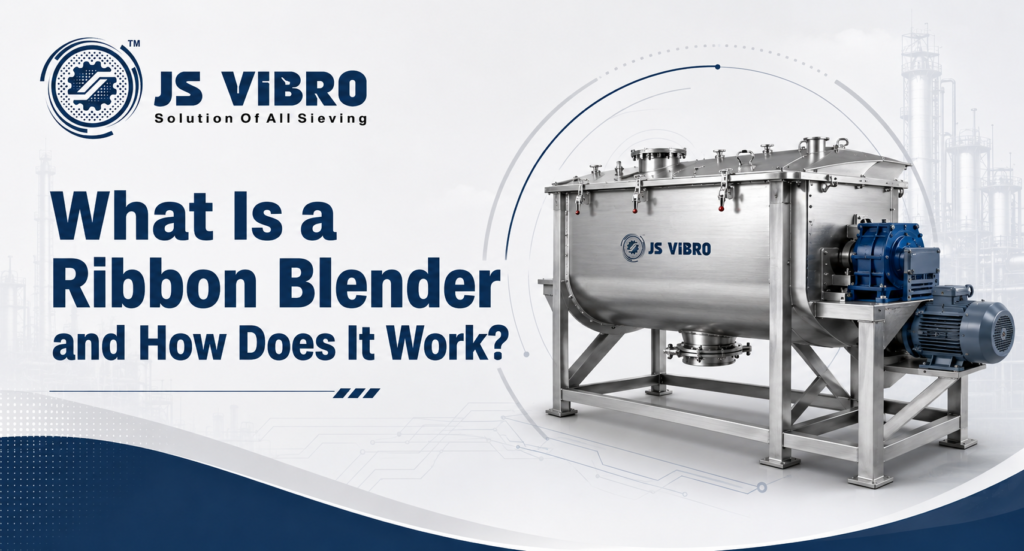
A ribbon blender is an industrial mixing machine used to blend dry powders, granules, and bulk solids. It is widely used in industries such as food processing, chemicals, pharmaceuticals, cosmetics, minerals, plastics, and animal feed.
The machine usually has a horizontal mixing chamber with a central shaft. Attached to this shaft are spiral-shaped ribbons that move the material in different directions. The outer ribbon moves the product toward the centre, while the inner ribbon pushes it back toward the sides. This continuous movement creates a smooth folding and mixing action, helping different ingredients combine evenly.
How Does a Ribbon Blender Work?
A ribbon blender works through a convective mixing process. As the shaft rotates, the ribbons lift, fold, and move the material throughout the chamber. This back-and-forth motion allows powders and solids to mix quickly and uniformly.
Even though ribbon blenders can complete mixing in a short time, they usually operate at a controlled speed. This makes them suitable for delicate or fragile materials because the gentle movement helps reduce product breakage. Depending on the formula, batch size, and material type, mixing may take only a few minutes or up to around 20 minutes.
Main Benefits of Ribbon Blenders
One of the biggest advantages of a ribbon blender is its versatility. It can be used for mixing dry powders, blending solids with solids, coating dry particles with liquid ingredients, and in some cases, handling slurry or liquid-particle suspension applications.
Ribbon blenders are also known for efficient discharge. Many machines use a central discharge outlet, allowing the blended product to leave the chamber easily. Plug valves are commonly used because they sit flush with the mixer body and help prevent material build-up during operation.
Another benefit is flexible working capacity. A ribbon blender generally needs enough material inside the chamber for the ribbons to contact and move the product properly. In many applications, the ideal working volume is around 50% to 70% of the mixer capacity.
Common Applications of Ribbon Blenders
Ribbon blenders are used for many materials and industries, including:
- Spices and food mixes
- Instant drink powders
- Nutraceuticals
- Cosmetics
- Polymers and plastic compounds
- Fertilisers
- Ceramic powders
- Pharmaceutical powders
- Chemical products
Because they provide fast, consistent, and gentle mixing, ribbon blenders are a popular choice for manufacturers handling dry bulk materials.
Important Things to Consider Before Choosing a Ribbon Blender
Before selecting a ribbon blender, it is important to understand the required batch volume and the bulk density of the ingredients. Heavier or denser materials may need a stronger motor, different gear ratios, or a heavy-duty design.
Surface finish is another important factor. For free-flowing powders, a standard finish may be enough. However, sticky, sanitary, or hygiene-sensitive products may require a smoother or polished internal surface to make cleaning easier and reduce the risk of cross-contamination.
Other useful features may include removable agitators, heating or cooling jackets, sampling devices, wear-resistant liners, variable frequency drives, and nitrogen purging for combustible materials.
Conclusion
A ribbon blender is a reliable and efficient solution for mixing powders, granules, and bulk solids. Its ribbon-shaped agitators create a gentle but effective mixing action, making it suitable for many industries and materials. By choosing the right design, capacity, motor power, and surface finish, manufacturers can improve product consistency, reduce mixing time, and support smoother production operations.


