

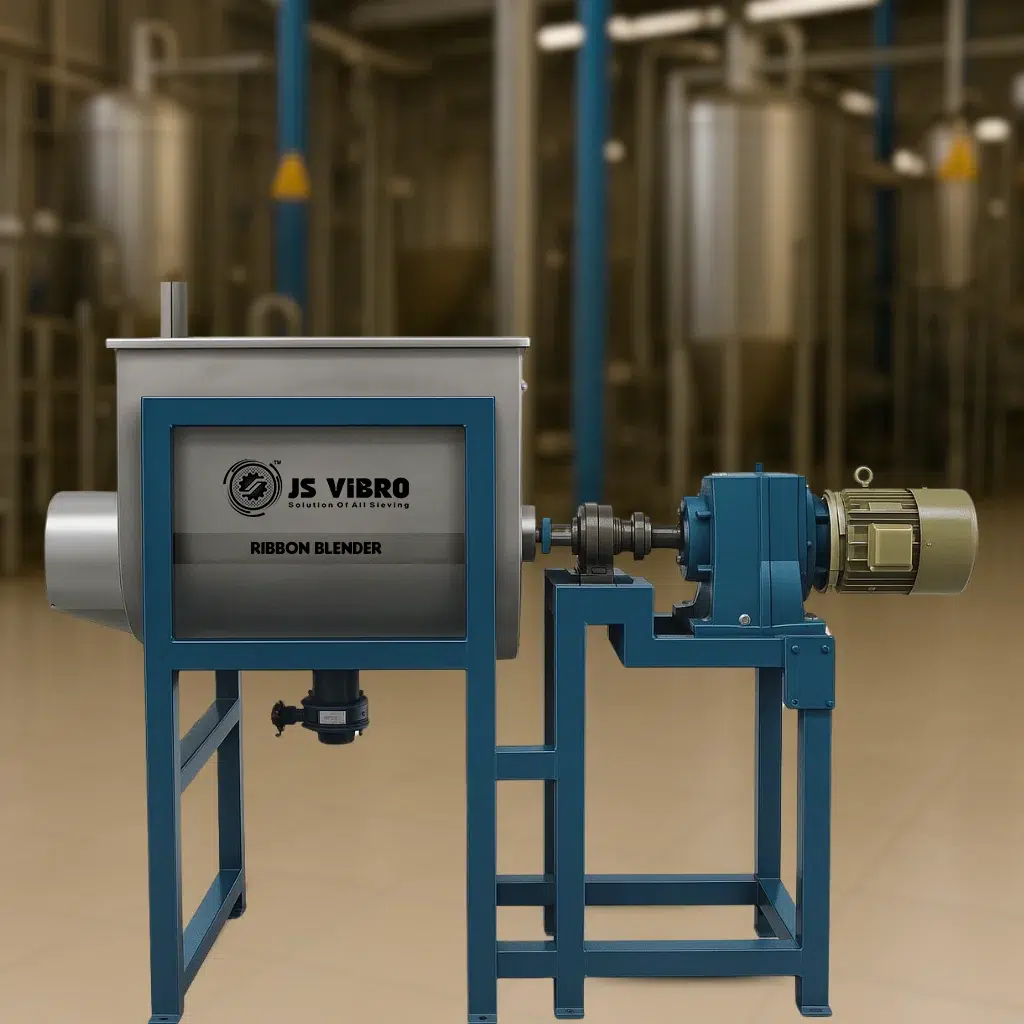
Ribbon Blender: Working Principle, Uses, and Applications
A ribbon blender is a widely used industrial mixing machine designed to blend powders, granules, and other dry materials into a uniform mixture. It is commonly used in industries where consistent mixing is important for product quality, such as food processing, pharmaceuticals, chemicals, cosmetics, and agriculture. The ribbon blender is known for its simple design, efficient mixing capability, and ability to handle large volumes of materials.
The machine consists of a horizontal U-shaped trough with a rotating shaft fitted with inner and outer helical ribbons. These ribbons move materials in opposite directions, ensuring that all particles are mixed thoroughly. Due to its reliable performance and cost-effectiveness, the ribbon blender has become an essential piece of equipment in many manufacturing processes.
Working Principle of Ribbon Blender
The ribbon blender works on the principle of convective mixing, where materials move in different directions inside the mixing chamber. The machine contains a horizontal shaft that rotates within a U-shaped trough. Attached to this shaft are two sets of helical ribbons: an inner ribbon and an outer ribbon.
When the shaft rotates, the outer ribbon moves materials from the ends of the trough toward the center, while the inner ribbon moves materials from the center toward the ends. This opposing movement creates a continuous flow of materials throughout the mixing chamber.
As the materials move back and forth within the trough, they repeatedly overlap and combine, resulting in a uniform mixture. The rotation speed and ribbon design ensure that materials are blended efficiently without causing excessive damage to the particles.
The mixing process usually takes only a few minutes, depending on the material properties and batch size. Once the mixing is complete, the blended material is discharged through a valve located at the bottom of the trough.
Main Components of a Ribbon Blender
A ribbon blender consists of several key components that work together to perform the mixing process effectively.
The U-shaped trough is the main chamber where the materials are placed for mixing. Its shape allows the ribbons to move materials smoothly and prevents accumulation in corners.
The ribbon agitator is the main mixing element. It consists of inner and outer helical ribbons that move materials in opposite directions to ensure thorough blending.
The central shaft supports the ribbon agitator and rotates to create the mixing action. It is connected to the motor through a gearbox.
The drive system, which includes the motor and gearbox, provides the power required to rotate the shaft and ribbons. The gearbox helps control the rotation speed for optimal mixing.
The discharge valve is located at the bottom of the trough and allows the mixed material to be released easily once the mixing process is complete.
The end plates and covers protect the mixing chamber and help maintain a controlled environment during operation.
Types of Ribbon Blenders
Ribbon blenders are available in different designs to suit various industrial needs.
The horizontal ribbon blender is the most common type. It is designed for batch mixing and is suitable for dry powders and granular materials.
The double ribbon blender features two sets of ribbons that improve mixing efficiency and provide better material movement inside the trough.
The paddle ribbon blender uses paddle-shaped blades instead of ribbons. This design is suitable for mixing delicate or fragile materials.
The continuous ribbon blender is designed for continuous production processes where materials are constantly fed into the machine and discharged after mixing.
Each type of ribbon blender is designed to meet specific mixing requirements depending on the nature of the material and the production process.
Applications of Ribbon Blender
Ribbon blenders are used in a wide range of industries because of their ability to mix materials efficiently.
In the food industry, ribbon blenders are used to mix ingredients such as flour, spices, sugar, powdered milk, and other dry food products. They help ensure consistent flavor and texture in food products.
In the pharmaceutical industry, ribbon blenders are used to mix active pharmaceutical ingredients with excipients to produce uniform formulations for tablets, capsules, and powders.
In the chemical industry, ribbon blenders are used for mixing chemicals, pigments, detergents, fertilizers, and other powdered substances.
The cosmetic industry also uses ribbon blenders to mix powders used in products such as face powders, talcum powders, and cosmetic pigments.
In the agriculture industry, ribbon blenders are used to mix animal feed, feed additives, and other agricultural products.
Because of their versatility, ribbon blenders can handle a wide variety of materials and mixing requirements.
Advantages of Ribbon Blender
Ribbon blenders offer several advantages that make them popular in industrial applications.
One of the main advantages is their efficient mixing capability. The opposing movement of the inner and outer ribbons ensures thorough mixing of materials.
Another advantage is their simple design, which makes them easy to operate and maintain. The machine has relatively few moving parts, reducing the risk of mechanical failure.
Ribbon blenders are also cost-effective, making them suitable for both small-scale and large-scale production facilities.
They can handle large batch sizes, which improves productivity in manufacturing operations.
Additionally, ribbon blenders provide consistent and uniform mixing, which is essential for maintaining product quality.
Advantages of Ribbon Blender
Proper maintenance is important to ensure the long-term performance of a ribbon blender. Regular inspection of the ribbons, shaft, and drive system helps prevent unexpected breakdowns.
Lubrication of moving parts and checking the tightness of bolts and connections are also essential maintenance practices. Cleaning the mixing chamber after each use is important, especially in industries such as food and pharmaceuticals where hygiene standards are strict.
Operators should also follow safety guidelines while using the machine. The machine should not be overloaded, and protective covers should remain in place during operation. Proper training of operators helps prevent accidents and ensures safe operation.
JS Vibro is a trusted manufacturer of high-quality Ribbon Blender Machines designed for efficient and uniform mixing of powders, granules, and dry materials. The company provides robust and precision-engineered ribbon blenders widely used in industries such as food processing, pharmaceuticals, chemicals, cosmetics, and agriculture. JS Vibro focuses on advanced manufacturing, durable construction, and user-friendly designs to deliver reliable performance and consistent mixing results. Their ribbon blenders are built using high-grade materials and modern technology to ensure long service life and minimal maintenance. With a strong commitment to quality, innovation, and customer satisfaction, JS Vibro delivers effective mixing solutions for various industrial applications.


